
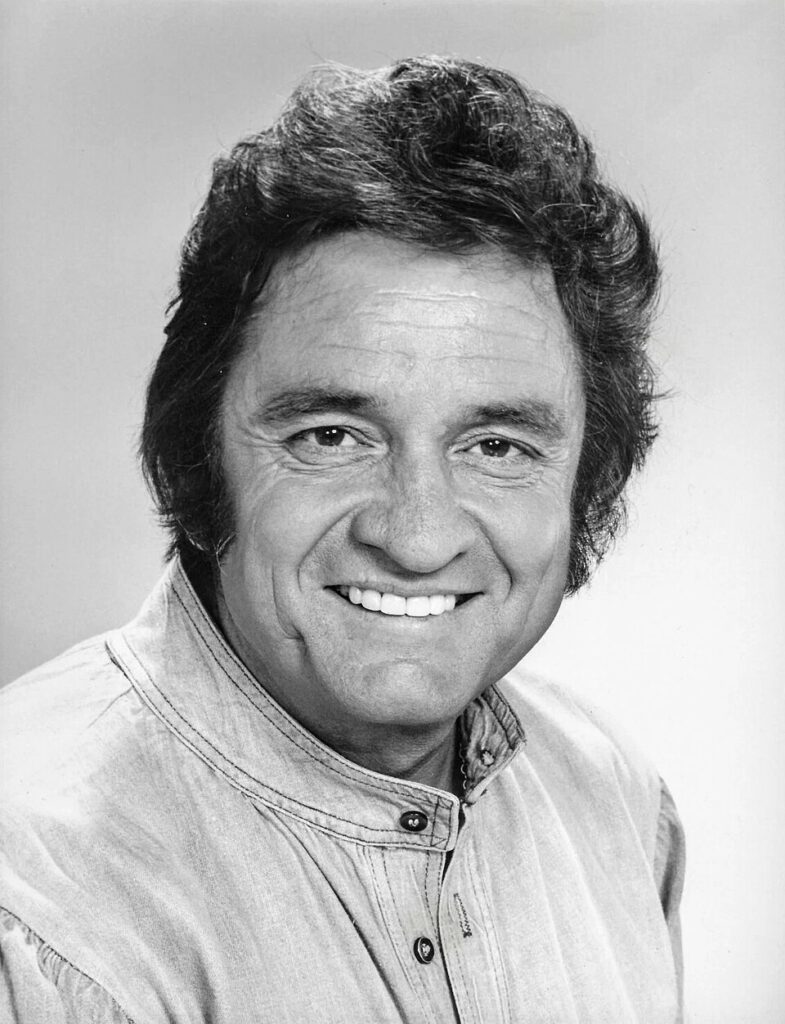
IN MEMORIAM 1932 – 2003
Johnny Cash
Guitar, Harmonica, Vocals with Johnny Cash & June Carter, Johnny Cash and the Tennessee Two, Million Dollar Quartet, The Highwaymen.
Blues Country Folk Gospel
Not rated0 Fans
John R. Cash (born J. R. Cash; February 26, 1932 – September 12, 2003) was an American singer-songwriter. Most of his music contains themes of sorrow, moral tribulation, and redemption, especially songs from the later stages of his career. He was known for his deep, calm, bass-baritone voice, the distinctive sound of his backing band, the Tennessee Three, that was characterized by its train-like chugging guitar rhythms, a rebelliousness coupled with an increasingly somber and humble demeanor, and his free prison concerts. Cash wore a trademark all-black stage wardrobe, which earned him the nickname "Man in Black".
Born to poor cotton farmers in Kingsland, Arkansas, Cash grew up on gospel music and played on a local radio station in high school. He served four years in the Air Force, much of it in West Germany. After his return to the United States, he rose to fame during the mid-1950s in the burgeoning rockabilly scene in Memphis, Tennessee. He traditionally began his concerts by introducing himself with "Hello, I'm Johnny Cash". He began to follow that by "Folsom Prison Blues", one of his signature songs. His other signature songs include "I Walk the Line", "Ring of Fire", "Get Rhythm", and "Man in Black". He also recorded humorous numbers like "One Piece at a Time" and "A Boy Named Sue", a duet with his future wife June called "Jackson" (followed by many further duets after they married), and railroad songs such as "Hey, Porter", "Orange Blossom Special", and "Rock Island Line". During his final years, Cash covered songs by contemporary rock artists; his covers included "Hurt" by Nine Inch Nails, "Rusty Cage" by Soundgarden, and "Personal Jesus" by Depeche Mode.
Cash is one of the best-selling music artists of all time, having sold more than 90 million records worldwide. His genre-spanning music embraced country, rock and roll, rockabilly, blues, folk, and gospel sounds. This crossover appeal earned him the rare honor of being inducted into the Country Music, Rock and Roll, and Gospel Music Halls of Fame. His life and career were dramatized in the 2005 biopic Walk the Line.
J. R. Cash was born on February 26, 1932, in Kingsland, Arkansas, to Carrie Cloveree (née Rivers) and Ray Cash. He had three older siblings, Roy, Margaret Louise, and Jack, and three younger siblings: Reba, Joanne, and Tommy (who also became a successful country artist). Because his mother wanted to name him John and his father preferred Ray, they compromised by giving him the initials "J. R." When Cash enlisted in the Air Force after high school, he was not permitted to use initials as a first name, so he adopted the name "John R. Cash". In 1955, when signing with Sun Records, he began using the name "Johnny Cash".
In March 1935, when Cash was three years old, the family settled in Dyess, Arkansas, a New Deal colony established during the Great Depression under President Franklin D. Roosevelt. The program was intended to give poor families the opportunity to work land they might eventually own. From the age of five, Cash worked in cotton fields with his family, singing with them as they worked. Dyess and the Cash farm suffered a flood during his childhood, an experience he later chronicled in the song "Five Feet High and Rising". His family's economic and personal struggles during the Great Depression gave him a lifelong sympathy for the poor and working class, inspiring many of his songs.
Biography summary from English Wikipedia, photograph via Wikimedia Commons.
1932
Born February 26, 1932 in United States
BIRTH
—
Member of Johnny Cash & June Carter
BAND
—
Member of Johnny Cash and the Tennessee Two
BAND
—
Member of Million Dollar Quartet
BAND
—
Member of The Highwaymen
BAND
2003
Died in 2003
IN MEMORIAM
1957
Johnny Cash With His Hot and Blue Guitar
ALBUM

1958
The Fabulous Johnny Cash
ALBUM
1959
Hymns by Johnny Cash
ALBUM
1959
Songs of Our Soil
ALBUM
1960
Ride This Train
ALBUM
1960
Now, There Was a Song!
ALBUM
1961
The Lure of the Grand Canyon
ALBUM
1962
The Sound of Johnny Cash
ALBUM
1962
Hymns From the Heart
ALBUM
1963
Blood, Sweat and Tears
ALBUM
1963
All Aboard The Blue Train
ALBUM
1963
The Christmas Spirit
ALBUM
1964
I Walk the Line
ALBUM
1964
Bitter Tears: Ballads of the American Indian
ALBUM
1964
Keep on the Sunny Side
ALBUM
1965
Johnny Cash Sings the Ballads of the True West
ALBUM
1965
Orange Blossom Special
ALBUM
1966
Everybody Loves a Nut
ALBUM
1966
Happiness Is You
ALBUM
1967
Carryin’ On With Johnny Cash & June Carter
ALBUM
1968
From Sea to Shining Sea
ALBUM
1969
The Holy Land
ALBUM
1970
Hello, I’m Johnny Cash
ALBUM
1971
Man in Black
ALBUM
1972
America: A 200-Year Salute in Story and Song
ALBUM
1972
A Thing Called Love
ALBUM
1973
Johnny Cash and His Woman
ALBUM
1973
Any Old Wind That Blows
ALBUM
1974
The Junkie and the Juicehead Minus Me
ALBUM
1974
Ragged Old Flag
ALBUM
1975
Johnny Cash Sings Precious Memories
ALBUM
1975
The Johnny Cash Children’s Album
ALBUM
1975
Look at Them Beans
ALBUM
1975
John R. Cash
ALBUM
1976
One Piece at a Time
ALBUM
1977
The Rambler
ALBUM
1977
The Last Gunfighter Ballad
ALBUM
1978
Gone Girl
ALBUM
1978
I Would Like to See You Again
ALBUM
1979
A Believer Sings the Truth
ALBUM
1979
Silver
ALBUM
1980
Sings with the BC Goodpasture Christian School
ALBUM
1980
Rockabilly Blues
ALBUM
1980
Classic Christmas
ALBUM
1981
The Baron
ALBUM
1982
The Adventures of Johnny Cash
ALBUM
1983
Johnny 99
ALBUM
1985
Rainbow
ALBUM
1986
Believe in Him
ALBUM
1986
Class of ’55: Memphis Rock & Roll Homecoming
ALBUM
1986
Heroes
ALBUM
1987
Johnny Cash Is Coming to Town
ALBUM
1988
Classic Cash: Hall of Fame Series
ALBUM
1988
Water From the Wells of Home
ALBUM
1989
Boom Chicka Boom
ALBUM
1990
Country Boy
ALBUM
1991
Country Christmas
ALBUM
1991
The Mystery of Life
ALBUM
1994
American Recordings
ALBUM
1996
Christmas Album
ALBUM
Discography via MusicBrainz.
Reviews
Average rating0Based on 0 ratings
5 ★0
4 ★0
3 ★0
2 ★0
1 ★0
Log in or sign up to rate and review.
Log In / Sign UpNo reviews yet for this artist.