
Tracklist
2:43
Dreams
Written by Stevie Nicks · Lead vocals Lindsey Buckingham, Christine McVie, Stevie NicksNever Going Back Again
Written by Lindsey Buckingham · Lead vocals Lindsey Buckingham, Christine McVie, Stevie NicksDon’t Stop
Written by Christine McVie · Lead vocals Lindsey Buckingham, Christine McVie, Stevie NicksGo Your Own Way
Written by Lindsey Buckingham · Lead vocals Lindsey Buckingham, Christine McVie, Stevie NicksSongbird
Written by Christine McVie · Lead vocals Lindsey Buckingham, Christine McVie, Stevie NicksThe Chain
Written by Lindsey Buckingham, Mick Fleetwood, Christine McVie, John McVie, Stevie Nicks · Lead vocals Lindsey Buckingham, Christine McVie, Stevie NicksYou Make Loving Fun
Written by Christine McVie · Lead vocals Lindsey Buckingham, Christine McVie, Stevie NicksI Don’t Want to Know
Written by Stevie Nicks · Lead vocals Lindsey Buckingham, Christine McVie, Stevie NicksOh Daddy
Written by Christine McVie · Lead vocals Lindsey Buckingham, Christine McVie, Stevie NicksGold Dust Woman
Written by Stevie Nicks · Lead vocals Stevie NicksThe Facts
- Released
- February 4, 1977
- Type
- Studio
- Genres
- pop rock, soft rock, Rock, Blues rock, art pop, folk rock
- Label
- Warner Bros. Records
- Producers
- Fleetwood Mac, Ken Caillat, Richard Dashut
- Recorded
- February–August 1976
- Length
- 39 minutes 3 seconds
- Tracks
- 11
Credited on this album




Story
Rumours is the eleventh studio album by the British and American rock band Fleetwood Mac, released on 4 February 1977, by Warner Bros. Records. Largely recorded in California in 1976, it was produced by the band with Ken Caillat and Richard Dashut. The recording sessions took place as the band members dealt with breakups with one another and struggled with heavy drug use, both of which shaped the album's direction and lyrics.
Recorded with the intention of making a pop album that would expand on the commercial success of their tenth studio album, Fleetwood Mac (1975), Rumours contains a mix of electric and acoustic instrumentation, accented rhythms, guitars, and keyboards, with lyrics concerning personal and often troubled relationships. Its release was postponed by delays in the mixing process. The band promoted the album with a worldwide concert tour.
Rumours became the band's first number-one album on the UK Albums Chart and also topped the US Billboard 200. It received multi-platinum certifications in Australia, Canada, Denmark, New Zealand, the United Kingdom, and the United States. As of February 2023, Rumours had sold over 40 million copies worldwide, making it one of the best-selling albums of all time. All of its four singles—"Go Your Own Way", "Dreams", "Don't Stop", and "You Make Loving Fun"—reached the top 10 of the US Billboard Hot 100, with "Dreams" reaching number one. In 2004, Rumours was remastered and reissued, with the addition of the track "Silver Springs" and outtakes from the recording sessions.
On release, the album garnered universal acclaim from critics, who praised its production quality and the vocal harmonies of the band's three singers, and won Album of the Year at the 1978 Grammy Awards. Retrospectively, Rumours has continued to receive acclaim and is widely considered Fleetwood Mac's magnum opus and one of the greatest albums of all time. It was inducted to the Grammy Hall of Fame in 2003 and was selected for preservation in the National Recording Registry in 2017 by the Library of Congress for being "culturally, historically, or aesthetically significant". In 2020, Rumours was ranked seventh in Rolling Stone's list of the "500 Greatest Albums of All Time".
Background
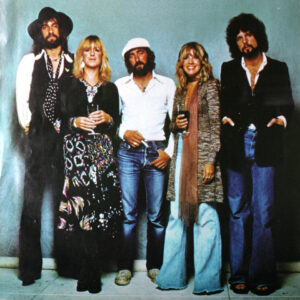
After guitarist Bob Welch left Fleetwood Mac in 1974, drummer Mick Fleetwood, keyboardist and vocalist Christine McVie, and bassist John McVie were joined by guitarist and singer Lindsey Buckingham and singer Stevie Nicks. In July 1975, Fleetwood Mac released its eponymous tenth album to great commercial success, reaching No. 1 in the U.S. in 1976; the record's singles "Over My Head", "Rhiannon" and "Say You Love Me" all reached the Top 20 there.
The band's success belied turmoil amongst its members; after six months of non-stop touring, the McVies divorced, ending eight years of marriage. The couple stopped talking to each other socially and discussed only musical matters. Buckingham and Nicks were having an on/off relationship that led them to fight often. The duo's arguments stopped only when they worked on songs together. Fleetwood faced domestic problems of his own after discovering that his wife Jenny, mother of his two children, was having an affair with his best friend.
Press intrusions into the band members' lives led to inaccurate stories. Christine McVie was reported to have been in the hospital with a serious illness, while Buckingham and Nicks were declared the parents of Fleetwood's daughter Lucy after being photographed with her. The press also wrote about a rumoured return of original Fleetwood Mac members Peter Green, Danny Kirwan, and Jeremy Spencer for a tenth anniversary tour. Despite false reports, the band did not change its lineup, although its members had no time to come to terms with the separations before recording for a new album began. Fleetwood has noted the "tremendous emotional sacrifices" made by everyone just to attend studio work. In early 1976, Fleetwood Mac crafted some new tracks in Florida. Fleetwood and John McVie fired their producer Keith Olsen because he favoured a lower emphasis on the rhythm section. The duo formed a company called Seedy Management to represent the band's interests.
Recording
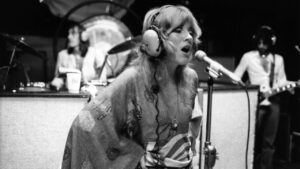
In February 1976, Fleetwood Mac convened at the Record Plant in Sausalito, California, with the engineers Ken Caillat and Richard Dashut. The three parties shared production duties, while the more technically adept Caillat was responsible for most of the engineering; he took a leave of absence from Wally Heider Studios in Los Angeles on the premise that Fleetwood Mac would eventually use their facilities. The set-up in Sausalito included several small recording rooms in a large, windowless, wooden building. Most band members complained about the studio and wanted to record at their homes, but Fleetwood did not allow any moves. Christine McVie and Nicks decided to live in two condominiums near the city's harbour, while the male contingent stayed at the studio's lodge in the adjacent hills. Recording occurred in a six-by-nine-metre (20 by 30 ft) room equipped with a 3M 24-track tape machine, a range of high-quality microphones, and an API mixing console with 550A equalisers; the latter were used to control frequency differences or a track's timbre. Although Caillat was impressed with the set-up, he felt that the room lacked ambience because of its "very dead speakers" and large amounts of soundproofing.
The record's working title in Sausalito was Yesterday's Gone. Buckingham took charge of the studio sessions to make "a pop album". According to Dashut, while Fleetwood and the McVies came from an improvisational blues rock background, the guitarist understood "the craft of record making". During the formative stages of compositions, Buckingham and Christine McVie played guitar and piano together to create the album's basic structures. The latter was the only classically trained musician in Fleetwood Mac, but both shared a similar sense of musicality. When the band jammed, Fleetwood often played his drum kit outside the studio's partition screen to better gauge Caillat's and Dashut's reactions to the music's groove. Baffles were placed around the drums and around John McVie, who played his bass guitar facing Fleetwood. Buckingham performed close to the rhythm section, while Christine McVie's keyboards were kept away from the drum kit. Caillat and Dashut spent about nine days working with a range of microphones and amplifiers to get a larger sound, before discovering they could adjust the sound effectively on the API mixing console.
As the studio sessions progressed, the band members' new intimate relationships that formed after various separations started to have a negative effect on Fleetwood Mac. The musicians did not meet or socialise after their daily work at the Record Plant. At the time, the hippie movement still affected Sausalito's culture and drugs were readily available. Open-ended budgets enabled the band and the engineers to become self-indulgent; sleepless nights and the extensive use of cocaine marked much of the album's production. Chris Stone, one of the Record Plant's owners, indicated in 1997 that Fleetwood Mac brought "excess at its most excessive" by taking over the studio for long and extremely expensive sessions; he stated, "The band would come in at 7 at night, have a big feast, party till 1 or 2 in the morning, and then when they were so whacked-out they couldn't do anything, they'd start recording".
Nicks has suggested that Fleetwood Mac created the best music when in the worst shape, while, according to Buckingham, the tensions between band members formed the recording process and led to "the whole being more than the sum of the parts". The couple's work became "bittersweet" after their final split, although Buckingham still had a skill for taking Nicks' tracks and "making them beautiful". The vocal harmonies between the duo and Christine McVie worked well and were captured using the best microphones available. Nicks' lyrical focus allowed the instrumentals in the songs that she wrote to be looser and more abstract. According to Dashut, all the recordings captured "emotion and feeling without a middle man ... or tempering". John McVie tended to clash with Buckingham about the make-up of songs, but both admit to achieving good outcomes. Christine McVie's "Songbird", which Caillat felt needed a concert hall's ambience, was recorded during an all-night session at Zellerbach Auditorium in Berkeley, across San Francisco Bay from Sausalito.
Following over two months in Sausalito, Fleetwood arranged a ten-day tour to give the band a break and get fan feedback. After the concerts, recording resumed at venues in Los Angeles, including Wally Heider Studios. Christine McVie and Nicks did not attend most of the sessions and took time off until they were needed to record any remaining vocals. The rest of Fleetwood Mac, with Caillat and Dashut, struggled to finalise the overdubbing and mixing of Rumours after the Sausalito tapes were damaged by repeated use during recording; the kick and snare drum audio tracks sounded "lifeless". A sell-out autumn tour of the US was cancelled to allow the completion of the album, whose scheduled release date of September 1976 was pushed back. A specialist was hired to rectify the Sausalito tapes using a vari-speed oscillator. Through a pair of headphones that played the damaged tapes in his left ear and the safety master recordings in his right, he converged their respective speeds aided by the timings provided by the snare and hi-hat audio tracks. The prolonged overdubbing process had also worn the 24-track master tape, leaving many of its sounds dull and flat by the time mixing began; engineers used the then-novel Aphex Aural Exciter, a harmonic enhancer, to restore some of the tape's lost top-end clarity. Fleetwood Mac and their co-producers wanted a "no-filler" final product, in which every track seemed a potential single. After the final mastering stage and hearing the songs back-to-back, the band members sensed they had recorded something "pretty powerful".
Lyrics
Fleetwood Mac's main songwriters—Buckingham, Christine McVie, and Nicks—worked individually on songs but sometimes shared lyrics. "The Chain" is the only track on which all members, including Fleetwood and John McVie, collaborated. All songs on Rumours concern personal, often troubled relationships. According to Christine McVie, the fact that the lyricists were focusing on the various separations became apparent to the band only in hindsight. "You Make Loving Fun" is about her boyfriend, Fleetwood Mac's lighting director, whom she dated after splitting from John. Nicks' "Dreams" details a breakup and has a hopeful message, while Buckingham's similar effort in "Go Your Own Way" is more pessimistic. After a short fling with a New England woman, he was inspired to write "Never Going Back Again", a song about the illusion of thinking that sadness will never occur again once content with life.
"Don't Stop", written by Christine McVie, is a song about optimism. She noted that Buckingham helped her craft the verses because their personal sensibilities overlapped. McVie's next track, "Songbird", features more introspective lyrics about "nobody and everybody" in the form of "a little prayer". "Oh Daddy", the last McVie song on the album, was written about Fleetwood and his wife Jenny Boyd, who had just got back together. The band's nickname for Fleetwood was "the Big Daddy". McVie commented that the writing is slightly sarcastic and focuses on the drummer's direction for Fleetwood Mac, which according to her always turned out to be right. Nicks' song "Gold Dust Woman" is inspired by Los Angeles and the hardship encountered in such a city. After struggling with the rock lifestyle, Nicks became addicted to cocaine; the lyrics address her belief in "keeping going".
Reviews
Average rating0Based on 0 ratings
5 ★0
4 ★0
3 ★0
2 ★0
1 ★0
Log in or sign up to rate and review.
Log In / Sign UpNo reviews yet for this album.
Community
Nobody has started a discussion about Rumours yet.