
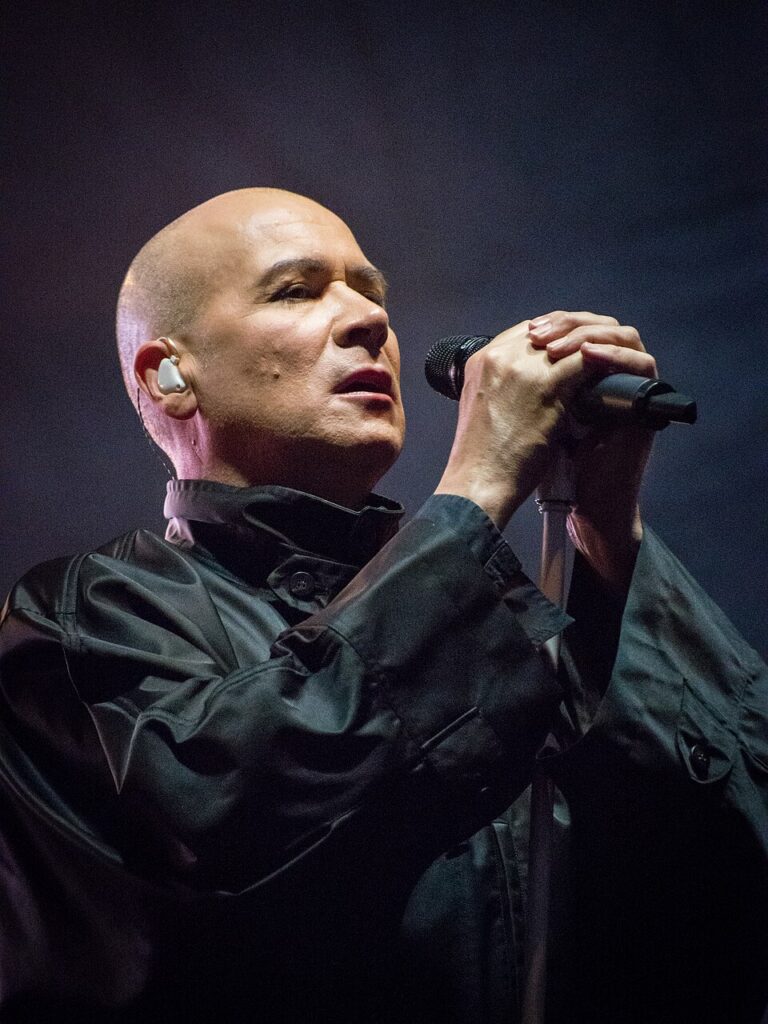
ARTIST PROFILE b. 1955
Phil Oakey
Keyboards, keytar, Vocals with Human League.
Electronic New Wave Synth-pop
Not rated0 Fans
Philip Oakey (born 2 October 1955) is an English singer-songwriter who is the frontman and co-founder of the synth-pop band the Human League. Aside from the Human League, he has enjoyed an extensive solo music career and has collaborated with numerous other artists and producers.
Oakey was among the most visually distinctive music artists of the early 1980s. At the height of their success, the Human League released the triple platinum-certified studio album Dare (1981) and Oakey co-wrote and sang the multimillion-selling single "Don't You Want Me", a #1 single in both the US and UK, where it remains the 28th-highest-selling single of all time. Oakey has been lead vocalist of the Human League for more than 40 years. With the band, he has sold more than 20 million records worldwide. He continues recording and performing internationally.
Oakey was born on 2 October 1955 in Hinckley, Leicestershire. He is of English and Irish descent. Oakey's father worked for the General Post Office and moved jobs regularly: the family moved to Coventry when Oakey was an infant, to Leeds when he was five and to Birmingham when he was nine, attending Catherine-de-Barnes primary school near Solihull and gaining a scholarship to the independent Solihull School. He settled in Sheffield when he was 14. He was educated at King Edward VII School in Sheffield. He left school at 18 without finishing his exams and worked in a number of casual jobs, including one in a university bookshop and as a hospital orderly at Thornbury Annex Hospital in Sheffield in 1977. In 1978, Oakey married his girlfriend Anthea Helliwell, whom he had met at school, but the marriage ended in divorce in 1980.
Oakey's entry into music in 1977 was unintentional. He purchased a saxophone but abandoned efforts to learn how to play it, and he had no aspiration to be in a pop group.
In Sheffield in 1977, Oakey's former schoolmate Martyn Ware, along with Ian Craig Marsh and Adi Newton, had formed a band called the Future. They were part of an emerging genre of music that used analogue synthesisers instead of traditional instruments, a style later termed synth-pop. Although they had recorded a number of demo tapes, the Future remained unsigned. Newton was fired by the band after they were rejected by record companies. Ware decided that the Future needed a dedicated lead singer to replace Newton. His first choice, Glenn Gregory, was unavailable, so Ware suggested Oakey to Marsh. Although Oakey had little music experience, he was well known in the Sheffield social scene for his eclectic dress sense and classic motorcycle. Ware invited Oakey to join the Future by leaving a note on Oakey's front door. Oakey joined the band in mid-1977.
Biography summary from English Wikipedia, photograph via Wikimedia Commons.
1955
Born October 2, 1955 in United Kingdom
BIRTH
1977
In Sheffield in 1977, Oakey's former schoolmate Martyn Ware, along with Ian Craig Marsh and Adi Newton, had formed a band called the Future.
MILESTONE
1977
Oakey joined the band in mid-1977.
MILESTONE
1981
At the height of their success, the Human League released the triple platinum-certified studio album Dare (1981) and Oakey co-wrote and sang the multimillion-selling single "Don't You Want Me", a #1 single in both…
MILESTONE
—
Member of Human League
BAND
Reviews
Average rating0Based on 0 ratings
5 ★0
4 ★0
3 ★0
2 ★0
1 ★0
Log in or sign up to rate and review.
Log In / Sign UpNo reviews yet for this artist.