
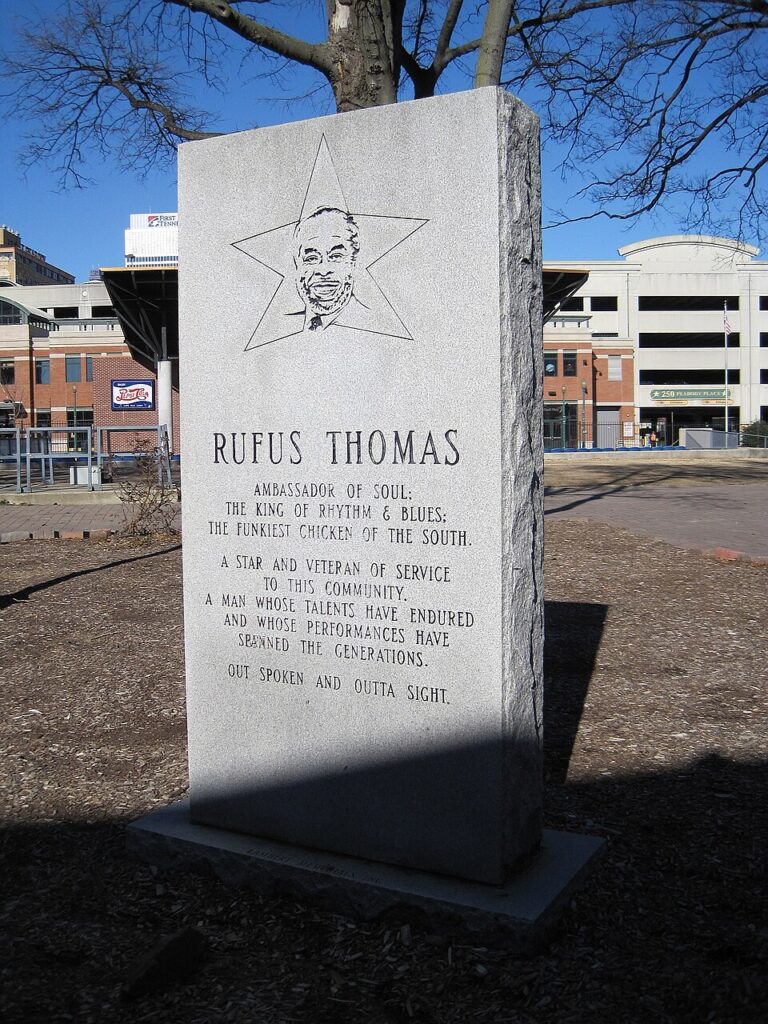
Rufus C. Thomas, Jr. (March 26, 1917 – December 15, 2001) was an American rhythm-and-blues, funk, soul and blues singer, songwriter, dancer, DJ and comic entertainer from Memphis, Tennessee. He recorded for several labels, including Chess Records and Sun Records in the 1950s, before becoming established in the 1960s and 1970s at Stax Records. His dance records, including "Walking the Dog" (1963), "Do the Funky Chicken" (1969), and "(Do the) Push and Pull" (1970), were some of his most successful songs. According to the Mississippi Blues Commission, "Rufus Thomas embodied the spirit of Memphis music perhaps more than any other artist, and from the early 1940s until his death . . . occupied many important roles in the local scene."
He began his career as a tap dancer, vaudeville performer, and master of ceremonies in the 1930s. He later worked as a disc jockey on radio station WDIA in Memphis, both before and after his recordings became successful. He remained active into the 1990s and as a performer and recording artist was often billed as "The World's Oldest Teenager". He was the father of the singers Carla Thomas (with whom he recorded duets) and Vaneese Thomas and the keyboard player Marvell Thomas.
Thomas was born in the rural community of Cayce, Mississippi, on the outskirts of Memphis, Tennessee, the son of a sharecropper. He moved with his family to Memphis around 1920. His mother was a "church woman". Thomas made his debut as a performer at the age of six, playing a frog in a school theatrical production. By the age of 10, he was a tap dancer, performing on the streets and in amateur productions at Booker T. Washington High School, in Memphis. From the age of 13, he worked with Nat D. Williams, his high-school history teacher, who was also a pioneer black DJ at radio station WDIA and columnist for black newspapers, as a master of ceremonies at talent shows in the Palace Theater on Beale Street. After graduating from high school, Thomas attended Tennessee A&I University for one semester, but economic constraints led him to leave to pursue a career as a full-time entertainer.
Thomas began performing in traveling tent shows. In 1936 he joined the Rabbit Foot Minstrels, an all-black revue that toured the South, as a tap dancer and comedian, sometimes part of a duo, Rufus and Johnny. He married Cornelia Lorene Wilson in 1940, at a service officiated by Rev. C. L. Franklin, the father of Aretha Franklin, and the couple settled in Memphis. Thomas worked a day job in the American Finishing Company textile bleaching plant, which he continued to do for over 20 years. He also formed a comedy and dancing duo, Rufus and Bones, with Robert "Bones" Couch, and they took over as MCs at the Palace Theater, often presenting amateur hour shows. One early winner was B.B. King, another was Al Hibbler, and others discovered by Thomas later in the 1940s included Bobby Bland and Johnny Ace.
In the early 1940s, Thomas began writing and performing his own songs. He regarded Louis Armstrong, Fats Waller and Gatemouth Moore as musical influences. He had already made his professional singing debut in the late 1930s at the Elks Club and as part of the Dub Jenkins band on Beale Street, often filling in for another singer Claude Jones. Also, during the 1940s he became a regular performer in Memphis nightclubs, such as Currie's Club Tropicana. As an established performer in Memphis, aged 33 in 1950, Thomas recorded his first 78 rpm single, for Jesse Erickson's small Star Talent label in Dallas, Texas. Thomas said, "I just wanted to make a record. I never thought of getting rich. I just wanted to be known, be a recording artist. . . . the record sold five copies and I bought four of them." The record, "I'll Be a Good Boy" backed with "I'm So Worried", gained a Billboard review, which stated that "Thomas shows first class style on a slow blues". He also recorded for the Bullet label in Nashville, Tennessee, when he recorded with Bobby Plater's Orchestra and was credited as "Mr. Swing"; the recordings were not recognised by researchers as being by Thomas until 1996. In 1951 he made his first recordings at Sam Phillips's Sun Studio, for the Chess label, but they were not commercially successful.
Biography summary from English Wikipedia, photograph via Wikimedia Commons.
1917
Born March 26, 1917 in United States
BIRTH
1936
In 1936 he joined the Rabbit Foot Minstrels, an all-black revue that toured the South, as a tap dancer and comedian, sometimes part of a duo, Rufus and Johnny.
MILESTONE
1950
As an established performer in Memphis, aged 33 in 1950, Thomas recorded his first 78 rpm single, for Jesse Erickson's small Star Talent label in Dallas, Texas.
MILESTONE
2001
Died in 2001
IN MEMORIAM
1963
Walking the Dog
STUDIO

1970
Do the Funky Chicken
STUDIO
1971
Rufus Thomas Live Doing The Push & Pull At P.J.'s
LIVE
1972
Did You Heard Me?
STUDIO
1973
Crown Prince of Dance
STUDIO
1977
If There Were No Music
STUDIO
1979
Chronicle: Their Greatest Stax Hits
COMPILATION
1981
Martha Reeves / Rufus Thomas / The Nashville Teens / The Troggs (La grande storia del rock)
COMPILATION
1988
That Woman Is Poison!
STUDIO
1992
Can't Get Away From This Dog
COMPILATION
1992
Timeless Funk
STUDIO
1993
The Best of Rufus Thomas: The Singles 1968-75
COMPILATION
1994
Rufus Thomas
COMPILATION
1995
Did You Heard Me? / Crown Prince of Dance
COMPILATION
1996
Blues Thang!
STUDIO
1996
The Best of Rufus Thomas: Do the Funky Somethin’
COMPILATION
1998
Memories
COMPILATION
1999
Best of the Best
STUDIO
1999
Funky Chicken
STUDIO
2002
The Funkiest Man: The Stax Funk Sessions 1967-1975
COMPILATION
2005
Just Because I'm Leavin'
STUDIO
2006
Stax Profiles
COMPILATION
2007
The Platinum Collection
COMPILATION
2007
The Very Best Of
COMPILATION
2008
Tiger Man: Earliest Recordings 1950-1957
COMPILATION
—
The Early Years
COMPILATION
Discography via MusicBrainz.
Reviews
Average rating0Based on 0 ratings
5 ★0
4 ★0
3 ★0
2 ★0
1 ★0
Log in or sign up to rate and review.
Log In / Sign UpNo reviews yet for this artist.