
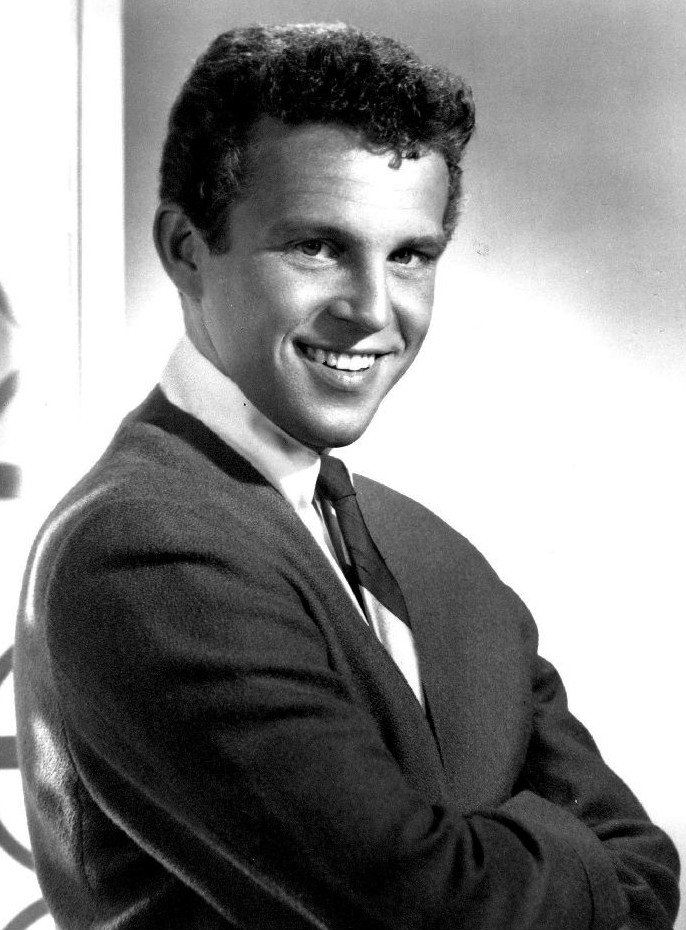
Stanley Robert Vinton (born April 16, 1935) is a retired American singer and actor, who hosted his own self-titled TV show in the late 1970s. As a teen idol, he became known as "The Polish Prince", as his music paid tribute to his Polish heritage. One of his most popular songs is "Blue Velvet" (a cover of the 1951 song recorded by Tony Bennett) which reached No. 1 on the Billboard Hot 100 in 1963, No. 1 in Canada (5 weeks), and number 2 in the UK in 1990.
Vinton was born in Canonsburg, Pennsylvania, the only child of locally popular bandleader Stan Vinton and Dorothy Studzinski Vinton. He is of Polish and Lithuanian descent. The family surname was originally Vintula, and was changed by Vinton's father. Vinton's parents encouraged their son's interest in music by giving him his daily 25-cent allowance after he had practiced the clarinet.
While attending Canonsburg High School when he was age 15, Vinton formed his first band, which played clubs around the Pittsburgh area. With the money he earned, he helped finance his college education at Duquesne University where he graduated with a degree in musical composition in 1956. While at Duquesne, he became proficient on all of the instruments in the band: piano, clarinet, saxophone, trumpet, drums, and oboe. When Vinton became an active musician, it was common for people to become confused with the bands of father and son, for both were named Stanley. Vinton's father suggested his son use his middle name of Robert professionally to clear up the confusion.
Vinton's birthplace of Canonsburg, Pennsylvania, is also the birthplace of Perry Como. Vinton's hometown named two streets, Bobby Vinton Boulevard and the shorter adjoining Bobby Vinton Drive, in his honor. These streets were built in the late 1970s; prior attempts to name a residential street after him failed. The residents had not cared for the singer always claiming Pittsburgh as his home town on TV interviews. Como always claimed Canonsburg as his hometown, so hundreds of people changed their address when the town renamed a street in the east end after Perry Como. The Canonsburg town fathers had plans to erect a statue in Vinton's honour, but Vinton himself vetoed the idea, noting that the $100,000 planned cost could go to far more important town needs.
According to his autobiography, Bobby was inspired to record his music by the Elvis Presley movie Jailhouse Rock. He formed his own record label, Bobby Records, in October 1958. His first release was "Twilight Time", backed with "Hallelujah". Bobby sang on the B-side of the 45 rpm release, making this his first commercially released vocal recording. This record did not chart. In March 1959, Bobby recorded for the Melody label out of Philadelphia, listed as "Bobby Vinton and his Orchestra" for the first time. His release of "Harlem Nocturne", backed with "Always in My Heart" with a vocal by Bobby, attracted attention in Pennsylvania. His 'young man with a big band' style was established here, and "Always In My Heart" was a song he returned to. In August 1959, Bobby moved to another larger record company, Alpine Records. He released two self-written singles for Alpine, the first being "You'll Never Forget" backed by "First Impression". The second Alpine release was "A Freshman and a Sophomore", backed with the self-written "The Sheik"; this was released in February 1960. Both Alpine releases garnered Billboard magazine mentions.
Biography summary from English Wikipedia, photograph via Wikimedia Commons.
1935
Born April 16, 1935 in United States
BIRTH
1958
He formed his own record label, Bobby Records, in October 1958.
MILESTONE
1960
The second Alpine release was "A Freshman and a Sophomore", backed with the self-written "The Sheik"; this was released in February 1960.
MILESTONE
1961
Bobby Vinton Plays for His Li'l Darlin's
STUDIO

1961
Dancing at the Hop
STUDIO
1962
Bobby Vinton Sings the Big Ones
STUDIO
1962
Roses Are Red and Other Songs for the Young and Sentimental
STUDIO
1963
Blue on Blue
STUDIO
1963
Songs Of Christmas
EP
1963
The Greatest Hits of the Golden Groups
STUDIO
1964
A Very Merry Christmas
STUDIO
1964
I Love How You Love Me
STUDIO
1964
Tell Me Why
STUDIO
1964
There! I've Said It Again
STUDIO
1965
Bobby Vinton Sings for Lonely Nights
STUDIO
1965
Drive-In Movie Time
STUDIO
1965
Mr. Lonely
STUDIO
1965
Theme From "Harlow" (Lonely Girl) / If I Should Lose Your Love
STUDIO
1966
Country Boy
STUDIO
1966
Live at the Copa
LIVE
1966
More of Bobby’s Greatest Hits
COMPILATION
1966
Satin Pillows and Careless
STUDIO
1967
Please Love Me Forever
STUDIO
1967
Sings The Newest Hits
STUDIO
1968
Take Good Care of My Baby
STUDIO
1969
Vinton
STUDIO
1970
Instrumental Sounds Of Love
STUDIO
1970
My Elusive Dreams
STUDIO
1972
Bobby Vinton’s All‐Time Greatest Hits
COMPILATION
1972
Ev'ry Day of My Life
STUDIO
1972
Sealed With a Kiss
STUDIO
1974
Melodies of Love
STUDIO
1974
With Love
COMPILATION
1975
Bobby Vinton Sings The Golden Decade Of Love
COMPILATION
1975
Heart of Hearts
STUDIO
1975
The Bobby Vinton Show
STUDIO
1976
Serenades of Love
STUDIO
1977
The Name Is Love
STUDIO
1978
Autumn Memories
COMPILATION
1979
Encore
STUDIO
1987
Sings Santa Must Be Polish and Other Christmas Sounds of Today
EP
1989
Timeless
COMPILATION
1990
Blue Velvet
COMPILATION
1990
Great Songs of Christmas
COMPILATION
1990
The 4 Bobbys - Their Greatest Hits
COMPILATION
1991
16 Most Requested Songs
COMPILATION
1991
Bobby Vinton -Greatest Polka Hits Of All Time
COMPILATION
1991
Bobby Vinton's Greatest Hits
COMPILATION
1991
Greatest Polka Hits of All Time
COMPILATION
1991
Mr. Lonely: His Greatest Songs Today
COMPILATION
1991
Roses Are Red My Love!
STUDIO
1994
The Best of Bobby Vinton
COMPILATION
1995
Kissin' Christmas: The Bobby Vinton Christmas Album
STUDIO
1995
The Branson Sound
COMPILATION
1997
Blue Velvet: His Greatest Hits
COMPILATION
1997
Greatest Hits
COMPILATION
2001
Bobby Vinton Classics
COMPILATION
2001
The Very Best of Bobby Vinton
COMPILATION
2002
20 All-Time Greatest Hits
COMPILATION
2002
Mr. Lonely / Country Boy
COMPILATION
2002
Take Good Care of My Baby / I Love How You Love Me
COMPILATION
2006
Because of You: The Love Songs Collection
COMPILATION
2006
Sealed With a Kiss / With Love
COMPILATION
2008
Bobby Vinton Collector Series, Volume III: Greatest Hits
COMPILATION
2017
Roses Are Red
COMPILATION
2021
The Classics
STUDIO
2024
Essential Classics, Vol. 525: Bobby Vinton
COMPILATION
—
Bobby Vinton Collectors Series, Volume II
COMPILATION
—
Bobby Vinton's Collector Series, Volume I
COMPILATION
—
My Greatest Hits
COMPILATION
—
Vinton Sings Vinton
COMPILATION
Discography via MusicBrainz.
Reviews
Average rating0Based on 0 ratings
5 ★0
4 ★0
3 ★0
2 ★0
1 ★0
Log in or sign up to rate and review.
Log In / Sign UpNo reviews yet for this artist.