

Tracklist
4:57
Rock and Roll
Written by John Bonham, John Paul Jones, Jimmy Page, Robert PlantThe Battle of Evermore
Written by Jimmy Page, Robert Plant · Lead vocals Sandy DennyStairway to Heaven
Written by Jimmy Page, Robert PlantMisty Mountain Hop
Written by John Paul Jones, Jimmy Page, Robert PlantFour Sticks
Written by Jimmy Page, Robert PlantGoing to California
Written by Jimmy Page, Robert PlantWhen the Levee Breaks
Written by John Bonham, John Paul Jones, Memphis Minnie, Jimmy Page, Robert PlantThe Facts
- Released
- November 8, 1971
- Type
- Studio
- Genres
- blues rock, folk rock, Hard rock, Heavy Metal, Rock
- Label
- Atlantic
- Producers
- Peter Grant, Jimmy Page
- Length
- 42 minutes 37 seconds
- Tracks
- 8
Credited on this album



Story
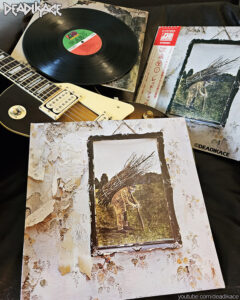
The untitled fourth studio album by the English rock band Led Zeppelin, commonly known as Led Zeppelin IV, was released on 8 November 1971, by Atlantic Records. It was produced by the band's guitarist, Jimmy Page, and recorded between December 1970 and February 1971, mostly in the country house Headley Grange. The album contains one of the band's best-known recordings, the eight-minute-long "Stairway to Heaven".
The informal recording environment inspired the band, allowing them to try different arrangements of material and create songs in various styles. After the previous album Led Zeppelin III (1970) received lukewarm reviews from critics, they decided their fourth album would officially be untitled and represented instead by four symbols – one chosen by each band member – without featuring the name or any other details on the cover. Unlike the prior two albums, the band was joined by guest musicians: singer Sandy Denny on "The Battle of Evermore", and pianist Ian Stewart on "Rock and Roll". As with prior albums, most of the material was written by the band, though there was one cover song, a hard rock re-interpretation of the Memphis Minnie blues song "When the Levee Breaks".
Led Zeppelin IV was an immediate critical and commercial success and is Led Zeppelin's best-selling album, having sold over 37 million copies worldwide. It is one of the best-selling albums in the United States and of all time, while critics have regularly placed it high on lists of the greatest albums of all time.
Writing and recording
Following the release of Led Zeppelin III in October 1970, the group took a break from live performances to concentrate on recording a follow-up. They turned down all touring offers, including a proposed New Year's Eve gig that would have been broadcast on television. They returned to Bron-Yr-Aur, a country house in Snowdonia, Wales, to write new material.
Recording sessions for the album began at Island Records' new studios on Basing Street in London on 5 December 1970, with the recording of "Black Dog". The group had considered Mick Jagger's home, Stargroves as a recording location, but decided it was too expensive. They subsequently moved the following month to Headley Grange, a country house in Hampshire, England, using the Rolling Stones Mobile Studio and engineer Andy Johns, with the Stones' Ian Stewart assisting. Johns had just worked on engineering Sticky Fingers and recommended the mobile studio. Guitarist and producer Jimmy Page later recalled: "We needed the sort of facilities where we could have a cup of tea and wander around the garden and go in and do what we had to do." This relaxed, atmospheric environment at Headley Grange also provided other advantages for the band, as they were able to capture spontaneous performances immediately, with some tracks arising from the communal jamming. Bassist and keyboardist John Paul Jones remembered there was no bar or leisure facilities, but this helped focus the group on the music without being distracted.
Once the basic tracks had been recorded, the band added overdubs at Island Studios in February. The band spent five days at Island, before Page then took the multitrack tapes to Sunset Sound in Los Angeles for mixing on 9 February, on Johns's recommendation, with a plan for an April 1971 release. Mixing would take ten days, before Page travelled back to London with the newly mixed material. The band had a playback at Olympic Studios. The band disliked the results, and so after touring through the spring and early summer, Page remixed the whole album in July. The album was delayed again over the choice of cover and whether it should be a double album, with a possible suggestion it could be issued as a set of EPs.
Title
After the lukewarm, if not confused and sometimes dismissive, critical reaction Led Zeppelin III had received in late 1970, Page decided that the next Led Zeppelin album would not have a title, but would instead feature four hand-drawn symbols on the inner sleeve and record label, each one chosen by the band member it represents. Atlantic Records were strongly against the idea, but the group stood their ground and refused to hand over the master tapes until their decision had been agreed to.
Page has also stated that the decision to release the album without any written information on the album sleeve was contrary to strong advice given to him by a press agent, who said that after a year's absence from both records and touring, the move would be akin to "professional suicide". Page thought, "We just happened to have a lot of faith in what we were doing." He recalled the record company were insisting that a title had to be on the album, but held his ground, as he felt it would be an answer to critics who could not review one Led Zeppelin album without a point of reference to earlier ones.
Releasing the album without an official title has made it difficult to consistently identify. While most commonly called Led Zeppelin IV, Atlantic Records catalogues have used the names Four Symbols and The Fourth Album. It has also been referred to as ZoSo (which Page's symbol appears to spell), Untitled and Runes. Page frequently refers to the album in interviews as "the fourth album" and "Led Zeppelin IV", and Plant thinks of it as "the fourth album, that's it". The original LP also has no text on the front or back cover, and lacks a catalogue number on the spine.
Packaging
In place of a title, Page decided each member could choose a personal emblem for the cover. Initially thinking of a single symbol, he then decided there could be four, with each member of the band choosing his own. He designed his own symbol and has never publicly disclosed any reasoning behind it. It has been argued that his symbol appeared as early as 1557 to represent Saturn. The symbol is sometimes referred to as "ZoSo", though Page has explained that it was not in fact intended to be a word at all. Jones's symbol, which he chose from Rudolf Koch's Book of Signs, is a single circle intersecting three vesicae piscis (a triquetra). It is intended to symbolise a person who possesses both confidence and competence. Bonham's symbol, the three interlocking (Borromean) rings, was picked by the drummer from the same book. It represents the triad of mother, father and child, but, also happens to be the logo for the steel and armament producer Krupp and, turned upside down, Ballantine beer. Plant's symbol of a feather within a circle was his own design, being based on the sign of the supposed Mu civilisation. A fifth, smaller symbol chosen by guest vocalist Sandy Denny represents her contribution to "The Battle of Evermore"; the figure, composed of three equilateral triangles, appears on the inner sleeve of the LP, serving as an asterisk.
Reviews
Average rating0Based on 0 ratings
5 ★0
4 ★0
3 ★0
2 ★0
1 ★0
Log in or sign up to rate and review.
Log In / Sign UpNo reviews yet for this album.
Community
Nobody has started a discussion about Led Zeppelin IV yet.
Articles
Fans
Deadikace fans who follow and made their profile public.