Tracklist
1:24
Dogs
Written by David Gilmour, Roger Waters · Lead vocals David Gilmour, Roger Waters, Richard WrightPigs (Three Different Ones)
Written by Roger Waters · Lead vocals Roger WatersSheep
Written by Roger Waters · Lead vocals Roger Waters, David GilmourPigs on the Wing, Part Two
Written by Roger Waters · Lead vocals Roger WatersThe Facts
- Released
- January 1977
- Type
- Studio
- Genres
- Progressive Rock, Art Rock, Blues Rock, Psychedelic Rock, Experimental Rock
- Label
- Columbia
- Producers
- Pink Floyd
- Recorded
- April–December 1976
- Length
- 41 minutes 31 seconds
- Tracks
- 5
Credited on this album
Story
Animals is the tenth studio album by the English rock band Pink Floyd, released on 21 January 1977, by Harvest Records and Columbia Records. It was produced by the band at their new studio, Britannia Row Studios, in London throughout 1976. The album continued the long-form compositions of Pink Floyd's previous works, such as Meddle (1971) and Wish You Were Here (1975).
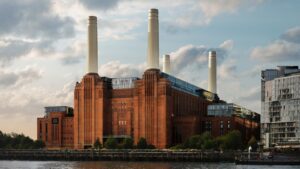
Animals is a concept album that focuses on the sociopolitical conditions of mid-1970s Britain. The cover was conceived by Roger Waters, the group's bassist and lead songwriter, and designed by long-time collaborator Storm Thorgerson. It shows an inflatable pig floating between two chimneys of Battersea Power Station.
Pink Floyd released no singles from Animals but promoted it through the In the Flesh tour. Waters' agitation with audiences during this tour inspired their next album, The Wall (1979). Animals reached number 2 in the UK and number 3 in the US. It initially received mixed reviews, but gained more favourable reviews in later years, and is considered by many to be one of Pink Floyd's greatest albums.
Recording
By 1975, Pink Floyd's deal with Harvest Records' parent company, EMI, for unlimited studio time in return for a reduced percentage of sales had expired. That year, Pink Floyd bought a three-storey block of church halls at 35 Britannia Row in Islington, north London. They converted it into a recording studio and storage facility, which took up most of 1975. In April 1976, Pink Floyd started work on their tenth studio album, Animals, at the new facility. It was engineered by a previous Floyd collaborator, Brian Humphries. Recording took place at Britannia Row between April 1976 and early 1977.
With the exception of "Dogs" (co-written by David Gilmour), the tracks were written by Roger Waters. Keyboardist Richard Wright contributed less than on previous albums, and Animals was the first Pink Floyd album not to contain a composer's credit for Wright.
"Raving and Drooling" and "You've Got to Be Crazy", songs previously performed live and considered for Pink Floyd's 1975 album Wish You Were Here, reappeared as "Sheep" and "Dogs", respectively. They were reworked to fit the new concept, and separated by "Pigs (Three Different Ones)". The only other new composition, "Pigs on the Wing" (split into two parts to start and end the album), references Waters' private life; his new romantic interest was Carolyne Anne Christie, who was married to Rock Scully, the manager of the Grateful Dead, when she met Waters.
The band had discussed employing another guitarist for future tours, and Snowy White was invited into the studio. When Waters and Mason inadvertently erased one of Gilmour's guitar solos, White was asked to record a solo on "Pigs on the Wing". Although his performance was omitted from the vinyl release, it was included on the 8-track cartridge version. White performed on the Animals tour. Mason recalled enjoying working on Animals more than Wish You Were Here.
Packaging
Once the album was complete, work began on its cover. Hipgnosis, designer of the band's previous album covers, offered three ideas, one of which was a small child entering his parents' bedroom to find them having sex: "copulating, like animals!"
The final concept was, unusually, designed by Waters. At the time, he lived near Clapham Common, London, and regularly drove past Battersea Power Station, which was approaching the end of its useful life. A view of the building was chosen for the cover image, and the band commissioned the German company Ballon Fabrik (who had previously constructed Zeppelin airships) and the Australian artist Jeffrey Shaw to build a 12-metre (40 ft) pig balloon (known as Algie). The balloon was inflated with helium and manoeuvred into position on 2 December 1976, with a marksman ready to fire if it escaped.
Inclement weather delayed work, and the band's manager Steve O'Rourke neglected to book the marksman for the following day; the balloon broke free of its moorings and disappeared from view. The pig flew over Heathrow, resulting in panic and cancelled flights; pilots also spotted the pig in the air. It eventually landed in Kent and was recovered by a local farmer, who was apparently furious that it had scared his cows. The balloon was recovered and filming continued for a third day, but as the early photographs of the power station were considered better, the image of the pig was later superimposed onto one of those taken by professional photographer Howard Bartrop on location on a residential block of flats adjacent.
During the Isles of Wonder short film shot by Danny Boyle and shown as part of the Opening Ceremonies of the 2012 Summer Olympics in London, the camera zooms down the length of the River Thames, from a small spring in the countryside all the way to the Olympic venue. During the fly-by, a pig can be seen floating above Battersea Power Station.
The album's theme continues onto the record's picture labels. Side one's label shows a fisheye lens view of a dog and the English countryside, and side two features a pig and sheep, in the same setting. Mason's handwriting is used as a typeface throughout the packaging. The gatefold features monochrome photographs of the dereliction around the power station.
Release
The album's release followed Capital Radio's broadcast two days earlier of The Pink Floyd Story, and an evening press conference held at the power station two days before that. The broadcast was originally to have been an exclusive for the DJ Nicky Horne, who since mid-December had been broadcasting The Pink Floyd Story, but a copy was given to John Peel, who played side one of the album in its entirety a day earlier.
Animals was released in the UK on 21 January 1977 on Harvest Records, and in the US on 12 February on Columbia Records. It reached number two in the UK and number three in the US. According to The Guinness Book of British Hit Albums, Pink Floyd overtook ABBA for the most weeks on the UK Albums Chart in 1977, at 108 weeks. Animals was certified quadruple platinum in the US on 31 January 1995.
Tour
Animals became the subject material for the band's In the Flesh Tour, which began in Dortmund on the same day the album was released. The tour continued through continental Europe in February, the UK in March, the United States for three weeks in April and May, and another three weeks in the United States in June and July. Algie became the inspiration for a number of pig themes used throughout. An inflatable pig was floated over the audience, and during each performance was replaced with a cheaper, but explosive version. On one occasion the mild propane gas was replaced with an oxygen-acetylene mixture, producing a massive (and dangerous) explosion. German promoter Marcel Avram presented the band with a piglet in Munich, only for it to leave a trail of broken mirrors and excrement across its mirrored hotel room, leaving manager O'Rourke to deal with the resulting fallout.
The band was augmented by familiar figures such as Dick Parry and Snowy White, but relations within the band became fraught. Waters took to arriving at the venues alone, departing as soon as each performance was over. On one occasion, Wright flew back to England, threatening to leave the band. The size of the venues was also an issue; in Chicago, the promoters claimed to have sold out the 67,000-person regular capacity of the Soldier Field stadium (after which ticket sales should have been ended), but Waters and O'Rourke were suspicious. They hired a helicopter, photographer and attorney, and discovered that the actual attendance was 95,000; a shortfall to the band of $640,000. The end of the tour was a low point for Gilmour, who felt that Pink Floyd had achieved the success they had sought and that there was nothing they could look forward to.
In July 1977 – on the final date at the Montreal Olympic Stadium – a small group of noisy and excited fans in the front row of the audience irritated Waters to such an extent that he spat at one of them, which he later said he immediately regretted. Gilmour also felt depressed about playing to such large audiences, and refused to join his bandmates for their third encore. Waters later spoke with the producer Bob Ezrin and told him of his sense of alienation on the tour, and how he sometimes felt like building a wall to separate himself from the audience. The incident formed the concept for the next Pink Floyd album, The Wall.
Reception
NME called Animals "one of the most extreme, relentless, harrowing and downright iconoclastic hunks of music to have been made available this side of the sun", and Melody Maker's Karl Dallas described it as an "uncomfortable taste of reality in a medium that has become in recent years, increasingly soporific". Rolling Stone's Frank Rose was unimpressed, writing: "The 1977 Floyd has turned bitter and morose. They complain about the duplicity of human behavior (and then title their songs after animals – get it?). They sound like they've just discovered this – their message has become pointless and tedious." Robert Christgau of The Village Voice gave the album a "B+" rating and found the negative reaction overly cynical, reasoning that the album functions simply as "a piece of well-constructed political program music ... lyrical, ugly, and rousing, all in the right places". Critic Mike Cormack said "Shorn of the lush textures of Dark Side or Wish You Were Here, Pink Floyd here are forbidding, stripped-down and muscular. Animals is to all intents and purposes their punk album; it has, with all deference to the Sex Pistols, a huge amount of bollocks. But it is largely undigestible by radio or compilation albums, and so it remains the lost great album of the Pink Floyd canon."
Legacy
In his 2004 autobiography Inside Out, Mason wrote that the album's perceived harshness, compared to previous Floyd releases, might have been the result of a "workman-like mood in the studio", and an unconscious reaction to accusations from some punk artists that bands like Pink Floyd represented "dinosaur rock".
Gilmour said on Westwood One's Pink Floyd 25th Anniversary Special about the album: "It wasn't one of the more productive periods of our life I don't think. We used those two tracks which went back to '74, changed the names, doctored them around and stuck them on the album. I love the album; it was exciting and noisy and fun. It really had some great bits and stuff of effects on there but it was not one of our creative high points really." Wright, on the BBC Omnibus Special in 1994, said: "I didn't really like a lot of the music on the album. I didn't fight hard to put my stuff on the album and I didn't have anything to put on. I played well but did not contribute to the writing and also Roger was not letting me write. This was the whole start of the whole ego thing in the band, Animals."
Reissues
Animals was issued on CD in the UK in 1985, and in the US in 1987. It was reissued as a digitally remastered CD with new artwork in 1994, and as a digitally remastered limited-edition vinyl album in 1997. An anniversary edition was released in the US in the same year, followed in 2000 by a reissue from Capitol Records. It was also included in the Shine On box set in 1992, in the 2007 Oh, By The Way box set and in the 2011 Why Pink Floyd...? re-release series both in the box set and as a standalone 'Discovery' edition CD.
Reviews
Average rating0Based on 0 ratings
5 ★0
4 ★0
3 ★0
2 ★0
1 ★0
Log in or sign up to rate and review.
Log In / Sign UpNo reviews yet for this album.
Community
Nobody has started a discussion about Animals yet.