
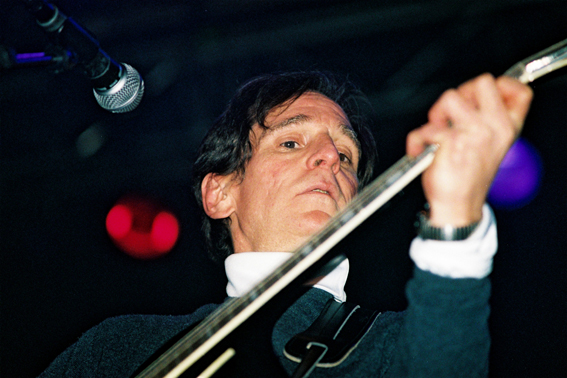
William Alexander Chilton (December 28, 1950 – March 17, 2010) was an American musician, best known as the lead singer of the rock bands the Box Tops and Big Star. Chilton's early commercial success in the 1960s as a teen vocalist for the Box Tops was not matched by similar chart success in his later work with Big Star and in his subsequent solo career on independent record labels. However, he built a devoted following among indie and alternative musicians, and has been frequently cited as a seminal influence by influential rock artists and bands.
Chilton grew up in a musical family. His father, Sidney Chilton, was a jazz pianist and saxophonist who sold industrial lighting to support his family. A local band recruited the teenaged Chilton in 1966 to be their lead singer after learning of the popularity of his vocal performance at a talent show at Memphis's Central High School. This band was Ronnie and the Devilles, which was subsequently renamed the Box Tops. The group recorded with Chips Moman and producer/songwriter Dan Penn at American Sound Studio and Muscle Shoals's FAME Studios.
Chilton was 16 when his first professional recording, the Box Tops' song "The Letter", became a number-one international hit. The Box Tops went on to have several other major chart hits, including "Neon Rainbow" (1967), "Cry Like a Baby" (1968), "Choo Choo Train" (1968), "Sweet Cream Ladies, Forward March" (1969), and "Soul Deep" (1969). Aside from "The Letter", "Neon Rainbow", and "Soul Deep", all written by Wayne Carson, many of the group's songs were written by Penn, Moman, Spooner Oldham, and other top area songwriters, with Chilton occasionally contributing a song. He also contributed a Carson song, "If I Cry," which was recorded in 1968 by the Memphis group the Debuts, featuring Jimi Jamison (future Survivor lead singer) on vocals. By late 1969, only Chilton and guitarist Gary Talley remained from the original group, and newer additions replaced the members who had departed. The group decided to disband and pursue independent careers in February 1970.
After deciding against enrolling as a student at Memphis State University, Chilton began performing as a solo artist, maintaining a working relationship with Penn for demos. During this period he began learning guitar by studying the styles of guitarists like Stax Records great Steve Cropper and Carl Wilson of the Beach Boys. Chilton began recording his own solo material in the fall of 1969 at Ardent Studios with local musicians including producer Terry Manning (who had worked with Chilton as an engineer on the Box Tops' recordings) and drummer Richard Rosebrough, and producing a few local blues-rock acts. His 1969–1970 recordings were released in the 1980s and 1990s on albums such as Lost Decade (New Rose Records), 1970 (Ardent Records), and Free Again: The "1970" Sessions" (Omnivore Recordings).
Chilton was considered as a replacement vocalist for Al Kooper in Blood, Sweat & Tears.
Biography summary from English Wikipedia, photograph via Wikimedia Commons.
1950
Born December 28, 1950 in United States
BIRTH
1969
His 1969–1970 recordings were released in the 1980s and 1990s on albums such as Lost Decade (New Rose Records), 1970 (Ardent Records), and Free Again: The "1970" Sessions" (Omnivore Recordings).
MILESTONE
—
Member of The Box Tops
BAND
2010
Died in 2010
IN MEMORIAM
1977
Singer Not The Song
EP

1978
One Day In New York
ALBUM
1979
Like Flies on Sherbert
ALBUM
1980
Bach's Bottom
ALBUM
1985
Feudalist Tarts
EP
1986
No Sex
EP
1987
High Priest
ALBUM
1989
Black List
ALBUM
1993
Clichés
ALBUM
1995
A Man Called Destruction
ALBUM
1996
Cubist Blues
ALBUM
1999
Loose Shoes and Tight Pussy
ALBUM
2015
Ocean Club '77
ALBUM
2018
The Death of Rock
ALBUM
2019
My Rival
EP
2022
Feudalist Tarts [Expanded]
EP
Discography via MusicBrainz.
Reviews
Average rating0Based on 0 ratings
5 ★0
4 ★0
3 ★0
2 ★0
1 ★0
Log in or sign up to rate and review.
Log In / Sign UpNo reviews yet for this artist.
Fans
Deadikace fans who follow and made their profile public.