
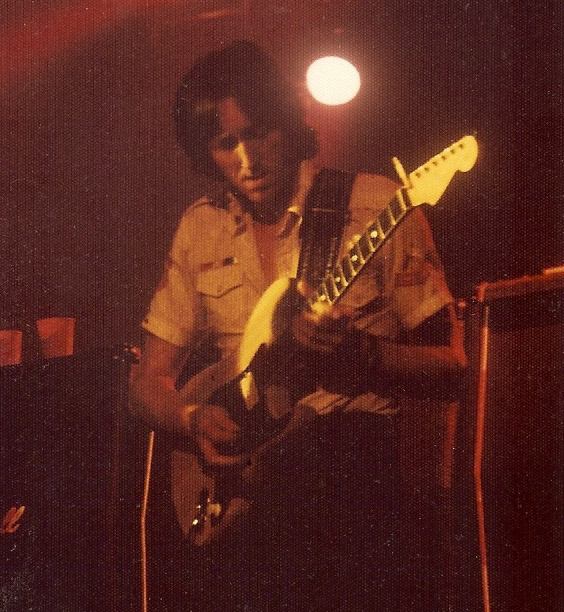
IN MEMORIAM 1946 – 2017
Allan Holdsworth
Guitar, SynthAxe, Violin.
Instrumental Rock Jazz Fusion Progressive Rock
Not rated2 Fans
Allan Holdsworth (6 August 1946 – 15 April 2017) was a British jazz and rock guitarist, violinist and composer. He contributed to numerous bands, including Soft Machine, U.K., The Tony Williams Lifetime, Pierre Moerlen's Gong, Bruford, Level 42, and Planet X, in addition to solo work in multiple genres.
Holdsworth was known for his esoteric and idiosyncratic usage of advanced music theory concepts, especially with respect to melody and harmony. His music incorporates a vast array of complex chord progressions, often using unusual chord shapes in an abstract way based on his understanding of "chord scales", and intricate improvised solos, frequently across shifting tonal centres. He used myriad scale forms often derived from those such as the Lydian, diminished, harmonic major, augmented, whole tone, chromatic and altered scales, among others, often resulting in an unpredictable and dissonant "outside" sound. His unique legato soloing technique stemmed from his original desire to play the saxophone, hence why he strove to use the guitar to create similarly smooth lines of notes. He also became associated with playing an early form of guitar synthesizer called the SynthAxe, made by a company he endorsed in the 1980s.
Holdsworth was born in Bradford, where he was raised by his maternal grandparents, Sam and Elsie Holdsworth. He was raised in a house on Priestman Street, and went to the nearby Drummond Street Middle School. Sam Holdsworth was a jazz pianist who had previously moved to London to pursue a career in music, but had eventually returned to Bradford. Holdsworth was given his first guitar at the age of 17 and received his initial music tuition from his grandfather. His professional career began when he joined the Glen South Band, which performed on the Mecca club circuit across Northern England.
Holdsworth first recorded in 1969 with the band 'Igginbottom on their lone release, 'Igginbottom's Wrench (later reissued under the group name of "Allan Holdsworth & Friends"). In 1971 he joined Sunship, an improvisational band featuring keyboardist Alan Gowen, future King Crimson percussionist Jamie Muir and bassist Laurie Baker. They played live but never released any recorded material. Next came a brief stint with jazz rock band Nucleus, with whom Holdsworth played on their 1972 album, Belladonna; likewise with progressive rock band Tempest, on their self-titled first studio album in 1973. His playing can also be heard on a live BBC Radio concert from that year, which was released several decades later in 2005 as part of Under the Blossom: The Anthology, a Tempest compilation album most notable for the song "Gorgon". There has been an urban myth, propagated in part by the singer Donovan, that Holdsworth played the fuzztone solo on Donovan's 1968 hit "Hurdy Gurdy Man", but the solo was actually played by Alan Parker.
During the middle part of the decade, Holdsworth worked with various well-known progressive rock and jazz fusion artists, including Soft Machine (Bundles and Land of Cockayne), The New Tony Williams Lifetime (Believe It and Million Dollar Legs), Pierre Moerlen's Gong (Gazeuse!, Expresso II and Time is the Key), and Jean-Luc Ponty (Enigmatic Ocean), experiences he valued—especially his time spent with drummer Tony Williams. In 1976 came the first of Holdsworth's many frustrations with the music industry, when CTI Records released a recording of what Holdsworth thought was a rehearsal session as an official studio album, Velvet Darkness. This angered Holdsworth, who said decades later that he still loathed the album intensely and wished it were never made public.
Biography summary from English Wikipedia, photograph via Wikimedia Commons.
1946
Born August 6, 1946 in United Kingdom
BIRTH
1971
In 1971 he joined Sunship, an improvisational band featuring keyboardist Alan Gowen, future King Crimson percussionist Jamie Muir and bassist Laurie Baker.
MILESTONE
1972
Next came a brief stint with jazz rock band Nucleus, with whom Holdsworth played on their 1972 album, Belladonna; likewise with progressive rock band Tempest, on their self-titled first studio album in 1973.
MILESTONE
1976
In 1976 came the first of Holdsworth's many frustrations with the music industry, when CTI Records released a recording of what Holdsworth thought was a rehearsal session as an official studio album, Velvet Darkness.
MILESTONE
2005
His playing can also be heard on a live BBC Radio concert from that year, which was released several decades later in 2005 as part of Under the Blossom: The Anthology, a Tempest compilation…
MILESTONE
2017
Died in 2017
IN MEMORIAM
1976
Velvet Darkness
ALBUM

1980
The Things You See
ALBUM
1980
Conversation Piece - Part 1 & 2
ALBUM
1982
i.o.u.
ALBUM
1983
Road Games
EP
1985
Metal Fatigue
ALBUM
1986
Atavachron
ALBUM
1987
Sand
ALBUM
1988
With a Heart in My Song
ALBUM
1989
Secrets
ALBUM
1992
Wardenclyffe Tower
ALBUM
1993
Hard Hat Area
ALBUM
1996
None Too Soon
ALBUM
1996
Heavy Machinery
ALBUM
1997
1997-06-06 Frankfurt Jazz Festival, Frankfurt, Germany
ALBUM
1999
The Sixteen Men of Tain
ALBUM
2001
Flat Tire: Music for a Non-Existent Movie
ALBUM
2009
Propensity
EP
Discography via MusicBrainz.
Reviews
Average rating0Based on 0 ratings
5 ★0
4 ★0
3 ★0
2 ★0
1 ★0
Log in or sign up to rate and review.
Log In / Sign UpNo reviews yet for this artist.