
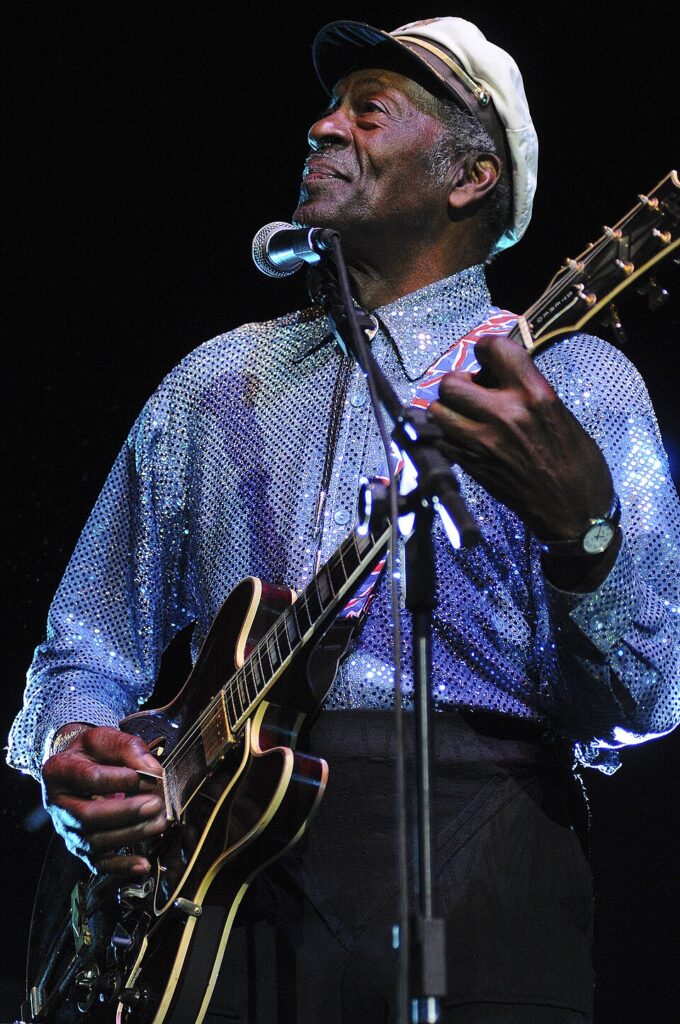
IN MEMORIAM 1926 – 2017
Chuck Berry
Guitar, Vocals with Chuck Berry & His Combo.
Rhythm and Blues Rock and Roll
Not rated0 Fans
Charles Edward Anderson Berry (October 18, 1926 – March 18, 2017) was an American guitarist, singer, and songwriter who was one of the pioneers of rock and roll. Nicknamed the "Father of Rock and Roll", he refined and developed rhythm and blues into the major elements that made rock and roll distinctive with songs such as "Maybellene" (1955), "Roll Over Beethoven" (1956), "Rock and Roll Music" (1957), and "Johnny B. Goode" (1958). Writing lyrics that focused on teen life, consumerism, and music itself, and developing a music style that included guitar solos and showmanship, Berry was a major influence on subsequent rock music.
Born into a middle-class family in St. Louis, Berry had an interest in music from an early age and gave his first public performance at Sumner High School. While still a high school student, he was convicted of armed robbery and was sent to a reformatory, where he was held from 1944 to 1947. After his release, Berry settled into married life and worked at an automobile assembly plant. By early 1953, influenced by the guitar riffs and showmanship techniques of the blues musician T-Bone Walker, Berry began performing with the Johnnie Johnson Trio. His break came when he traveled to Chicago in May 1955 and met Muddy Waters, who suggested he contact Leonard Chess, of Chess Records. With Chess, he recorded "Maybellene"—Berry's adaptation of the country song "Ida Red"—which sold over a million copies, reaching number one on Billboard's rhythm and blues chart.
By the end of the 1950s, Berry was an established star, with several hit records and film appearances and a lucrative touring career. He had also established his own St. Louis nightclub, Berry's Club Bandstand. He was sentenced to three years in prison in January 1962 for offenses under the Mann Act—he had transported a 14-year-old girl across state lines for the purpose of having sex. After his release in 1963, Berry had several more successful songs, including "No Particular Place to Go", "You Never Can Tell", "Nadine" and the novelty song "My Ding-a-Ling"—his only number-one single. However, none of them achieved the same lasting impact of his 1950s songs, and by the 1970s he was more in demand as a nostalgia performer, playing his past material with local backup bands of variable quality.
Berry was among the first musicians to be inducted into the Rock and Roll Hall of Fame on its opening in 1986; he was cited for having "laid the groundwork for not only a rock and roll sound but a rock and roll stance." Berry is included in several of Rolling Stone magazine's "greatest of all time" lists; he was ranked fifth on its 2004 and 2011 lists of the 100 Greatest Artists of All Time and 2nd greatest guitarist of all time in 2023. The Rock and Roll Hall of Fame's 500 Songs That Shaped Rock and Roll includes three of Berry's: "Johnny B. Goode", "Maybellene", and "Rock and Roll Music". "Johnny B. Goode" is the only rock-and-roll song included on the Voyager Golden Record.
Charles Edward Anderson Berry was born on October 18, 1926, in St Louis, the youngest child of Henry William Berry and Martha Bell Berry (née Banks). He grew up in the north St Louis neighbourhood known as the Ville, an area where many middle-class people lived. His father, Henry (1895–1987), was a contractor and deacon of a nearby Baptist church; his mother, Martha (1894–1980), was a certified public school principal. Berry's upbringing allowed him to pursue his interest in music from an early age. He gave his first public performance in 1941 while still a student at Sumner High School in St Louis; he was still a student there in 1944 when he was arrested for armed robbery after robbing three shops in Kansas City, Missouri and then stealing a car at gunpoint with some friends. Berry's account in his autobiography is that his car broke down and he flagged down a passing car and stole it at gunpoint with a non-functional pistol. He was convicted and sent to the Intermediate Reformatory for Young Men (now the Algoa Correctional Center) in Jefferson City, Missouri, where he formed a singing quartet and did some boxing. The singing group became competent enough that the authorities allowed it to perform outside the detention facility. Berry was released from the reformatory on his 21st birthday in 1947.
Biography summary from English Wikipedia, photograph via Wikimedia Commons.
1926
Born October 18, 1926 in United States
BIRTH
1952–1955
Music career beginnings
CAREER
1955–1962
Signing with Chess: "Maybellene" to "Come On"
CAREER
1963–1969
"Nadine" and move to Mercury
CAREER
1970–1979
Back to Chess: "My Ding-a-Ling" to White House concert
CAREER
1980–2017
Last years on the road
CAREER
—
Member of Chuck Berry & His Combo
BAND
2017
Died in 2017
IN MEMORIAM
1957
After School Session
ALBUM

1958
One Dozen Berrys
ALBUM
1959
Chuck Berry Is on Top
ALBUM
1960
Rockin’ at the Hops
ALBUM
1961
New Juke Box Hits
ALBUM
1964
St. Louis to Liverpool
ALBUM
1964
Two Great Guitars
ALBUM
1965
Chuck Berry in London
ALBUM
1965
Fresh Berry’s
ALBUM
1967
Chuck Berry in Memphis
ALBUM
1967
Chuck Berry’s Golden Hits
ALBUM
1968
From St. Louie to Frisco
ALBUM
1969
Concerto in “B Goode”
ALBUM
1970
Back Home
ALBUM
1971
San Francisco Dues
ALBUM
1973
Bio
ALBUM
1975
Chuck Berry '75
ALBUM
1979
Rockit
ALBUM
1997
In Concert
ALBUM
2011
Icon
ALBUM
2017
Chuck
ALBUM
2017
Live: The Palladium New York ‘88 + Bonus Track
ALBUM
2021
Reelin' And Rockin' - 60 Essential Recordings
ALBUM
Discography via MusicBrainz.
Reviews
Average rating0Based on 0 ratings
5 ★0
4 ★0
3 ★0
2 ★0
1 ★0
Log in or sign up to rate and review.
Log In / Sign UpNo reviews yet for this artist.