
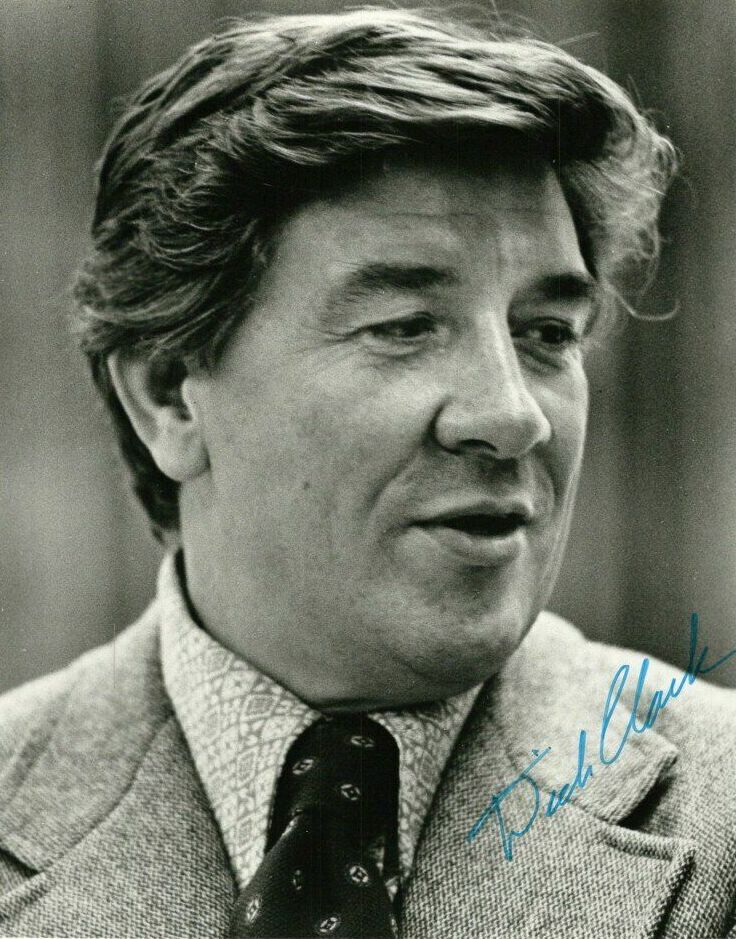
Richard Clarence Clark (September 14, 1928 – September 20, 2023) was an American politician from Iowa who served as a member of the United States Senate for one term from 1973 to 1979. He was a member of the Democratic Party. After he left the United States Senate, Clark was known for a major role in helping refugees of the Vietnam War.
Richard Clarence Clark was born on September 14, 1928, in Paris, Iowa, an unincorporated community in Linn County, Iowa to Clarence Clark and the former Bernice Andersen, who owned a grocery store near the village of Lamont, Iowa, where they moved to when Dick was young. He was of German and English descent. Clark attended public schools. He graduated from Lamont High School in 1947 and enlisted in the United States Army, serving in Europe during the Korean War. Clark was educated at the University of Maryland Global Campus in Wiesbaden and Goethe University Frankfurt from 1950 to 1952 during his military service. He completed his BA in 1953 at Upper Iowa University and his Master's in 1956 at the University of Iowa. He then became a professor at Upper Iowa University and a Democratic Party volunteer, working to collect names, addresses, and phone numbers of party members with the goal of contacting them on election day to get them to the polls. This resulted in Democratic victories in an otherwise Republican area.
This caught the attention of attorney John Culver of Cedar Rapids, Iowa, who enlisted Clark to help run his congressional campaign in 1964. After their victory, Clark became Culver's administrative assistant, and the pair modernized the Iowa Democratic Party's grassroots efforts in the state, building up a sophisticated voter turnout organization that progressed from names on index cards to computerized databases.
In 1971, Culver was contemplating running for the U.S. Senate. He dispatched Clark to travel the state to set up infrastructure for a potential campaign. But in early 1972, Culver decided that defeating entrenched incumbent Republican Senator Jack Miller was impossible and bowed out of the race. With the infrastructure set up and no other Democratic candidate in the race, Clark entered it himself.
Throughout the campaign, polls showed Clark trailing Miller by lopsided margins. A critical part of Clark's campaign was his 1,300-mile (2,100 km) walk across the state to gain publicity. He won in an upset, with 662,637 votes (55%) to Miller's 530,525 (44%). American Independent Party candidate William Rocap received 8,954 votes (1%). In 1974, Clark was joined by Culver, his former boss, who rode to victory because of the Republican Party's unpopularity in the wake of the Watergate scandal.
Biography summary from English Wikipedia, photograph via Wikimedia Commons.
1929
Born November 30, 1929 in United States
BIRTH
1974
In 1974, Clark was joined by Culver, his former boss, who rode to victory because of the Republican Party's unpopularity in the wake of the Watergate scandal.
MILESTONE
2023
Died in 2023
IN MEMORIAM
Reviews
Average rating0Based on 0 ratings
5 ★0
4 ★0
3 ★0
2 ★0
1 ★0
Log in or sign up to rate and review.
Log In / Sign UpNo reviews yet for this artist.