
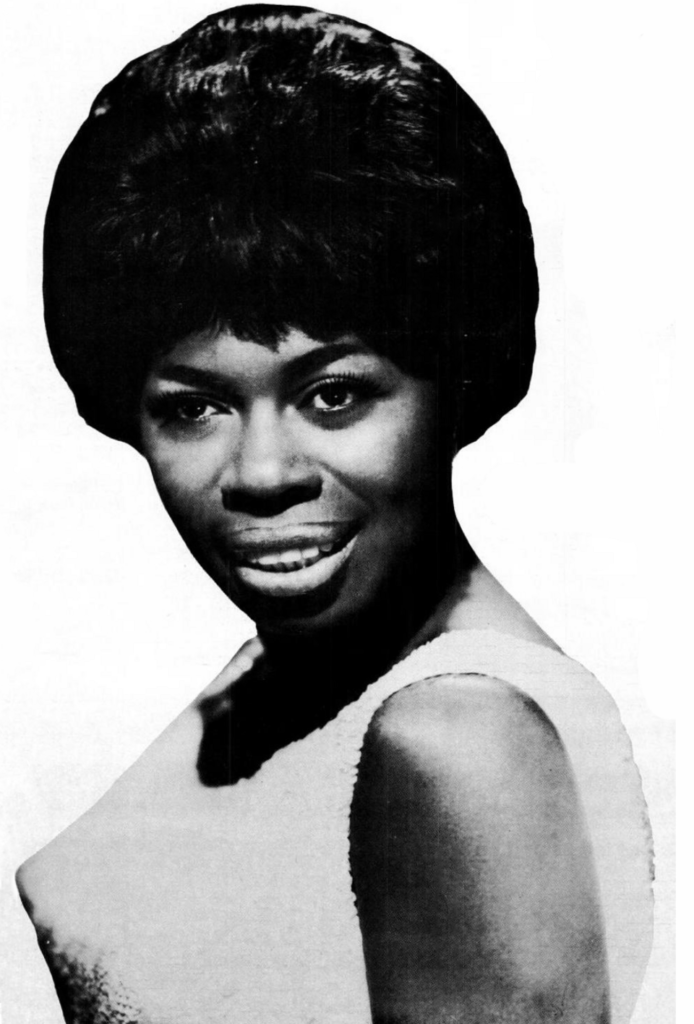
Esther Phillips (December 23, 1935 – August 7, 1984), born Esther Mae Jones, was an American singer, best known for her R&B vocals. She rose to prominence in 1950, scoring several major R&B hits including "Double Crossing Blues" and "Mistrustin' Blues" under the moniker "Little Esther." In the 1960s, she achieved chart success with the country song "Release Me" and recorded in the pop, jazz, blues and soul genres. Phillips received four Grammy nominations, including for her album From a Whisper to a Scream in 1973, as well as for the album that featured her disco recording of "What a Diff'rence a Day Makes," which was a major hit in 1975. She died from liver and kidney failure due to long-term drug abuse in 1984.
Esther Phillips was born Esther Mae Jones in Galveston, Texas, the daughter of Arthur Jones and Lucille (née) Washington. Her parents divorced during her adolescence, and she divided her time between her father, in Houston, and her mother, in the Watts section of Los Angeles. She was brought up singing in church and was reluctant to enter a talent contest at a local blues club, but her sister insisted. A mature singer at the age of 14, she won the amateur talent contest in 1949 at the Barrelhouse Club, owned by Johnny Otis. Otis was so impressed that he recorded her for Modern Records and added her to his traveling revue, the California Rhythm and Blues Caravan, billed as Little Esther. She later took the surname Phillips as her stage name, reportedly inspired by a sign at a gas station.
Her first hit record was "Double Crossing Blues", with the Johnny Otis Quintette and the Robins (a vocal group), released in 1950 by Savoy Records, which reached number 1 on the Billboard R&B chart. She made several hit records for Savoy with the Johnny Otis Orchestra, including "Mistrusting Blues" (a duet with Mel Walker) and "Cupid's Boogie", both of which also went to number 1 that year. Four more of her records made the Top 10 in the same year: "Misery" (number 9), "Deceivin' Blues" (number 4), "Wedding Boogie" (number 6), and "Far Away Blues (Xmas Blues)" (number 6). Few female artists performing in any genre had such success in their debut year.
Phillips left Otis and the Savoy label at the end of 1950 and signed with Federal Records. But just as quickly as the hits had started, they stopped. She recorded more than thirty sides for Federal, but only one, "Ring-a-Ding-Doo", made the charts, reaching number 8 in 1952. Not working with Otis was part of her problem; the other part was her deepening dependence on heroin, to which she was addicted by the middle of the decade.
In 1954, she returned to Houston to live with her father and recuperate. Short on money, she worked in small nightclubs around the South, punctuated by periodic hospital stays in Lexington, Kentucky, to treat her addiction. In 1962, Kenny Rogers discovered her singing at a Houston club and helped her get a contract with Lenox Records, owned by his brother Lelan.
Biography summary from English Wikipedia, photograph via Wikimedia Commons.
1935
Born December 23, 1935 in United States
BIRTH
1949
A mature singer at the age of 14, she won the amateur talent contest in 1949 at the Barrelhouse Club, owned by Johnny Otis.
MILESTONE
1950
Her first hit record was "Double Crossing Blues", with the Johnny Otis Quintette and the Robins (a vocal group), released in 1950 by Savoy Records, which reached number 1 on the Billboard R&B chart.
MILESTONE
1950
Phillips left Otis and the Savoy label at the end of 1950 and signed with Federal Records.
MILESTONE
1954
In 1954, she returned to Houston to live with her father and recuperate.
MILESTONE
1973
Phillips received four Grammy nominations, including for her album From a Whisper to a Scream in 1973, as well as for the album that featured her disco recording of "What a Diff'rence a Day…
MILESTONE
1984
Died in 1984
IN MEMORIAM
1962
Release Me! Reflections of Country and Western Greats
STUDIO

1965
And I Love Him
STUDIO
1966
Esther Phillips Sings
STUDIO
1966
The Country Side of Esther Phillips
STUDIO
1970
Burnin’: Live at Freddie Jett’s Pied Piper, L.A.
LIVE
1971
From a Whisper to a Scream
STUDIO
1972
Alone Again, Naturally
STUDIO
1973
Black‐Eyed Blues
STUDIO
1974
Performance
STUDIO
1975
What a Diff’rence a Day Makes
STUDIO
1976
Capricorn Princess
STUDIO
1976
Confessin’ the Blues
STUDIO
1976
For All We Know
STUDIO
1978
All About
STUDIO
1979
Here's Esther...Are You Ready
STUDIO
1979
Ladies Sing the Blues: Roots of Rock ’n’ Roll, Vol. 5
COMPILATION
1984
The Complete Savoy Recordings With Johnny Otis
COMPILATION
1985
Bad Baad Girl!
COMPILATION
1986
A Way to Say Goodbye
STUDIO
1986
Set Me Free
COMPILATION
1988
I Paid My Dues
COMPILATION
1990
Better Beware
COMPILATION
1990
The Best of Esther Phillips
COMPILATION
1995
It’s a Blues Thing
STUDIO
1995
The Rising Sun Collection
LIVE
1997
The Best of Esther Phillips, 1962–1970
COMPILATION
1998
Burnin’ / Confessin’ the Blues
COMPILATION
1999
And I Love Him! / Esther
COMPILATION
2003
Anthology
COMPILATION
2003
Blues & Rhythm Series: The Chronological Little Esther 1951-1952
COMPILATION
2004
Home Is Where the Hatred Is: The Kudu Years 1971-1977
COMPILATION
2005
Blues & Rhythm Series: The Chronological Little Esther 1952-1953
COMPILATION
2005
Jazz Moods: Hot
COMPILATION
2005
The Best of Little Esther
COMPILATION
2006
Mistrustin’ and Deceivin’
COMPILATION
2006
Release Me
STUDIO
2006
The Atlantic Years
COMPILATION
2010
The Early Hits 1949-1954
COMPILATION
2011
Here’s Esther … Are You Ready? / Good Black Is Hard To Crack
COMPILATION
2011
You’ve Come a Long Way, Baby / All About Esther Phillips
COMPILATION
2014
Baby I’m for Real! 1971–1974
COMPILATION
2017
A Beautiful Friendship (The Kudu Anthology 1971–1976)
COMPILATION
2017
At Onkel Pö’s Carnegie Hall Hamburg 1978
LIVE
2018
The Essential Esther Phillips: The KUDU Years
COMPILATION
2020
Brand New Day: The Lenox / Atlantic & Roulette Recordings (1962-1970)
COMPILATION
2021
The Warwick Singles
EP
—
Double Crossing Blues
COMPILATION
Discography via MusicBrainz.
Reviews
Average rating0Based on 0 ratings
5 ★0
4 ★0
3 ★0
2 ★0
1 ★0
Log in or sign up to rate and review.
Log In / Sign UpNo reviews yet for this artist.