
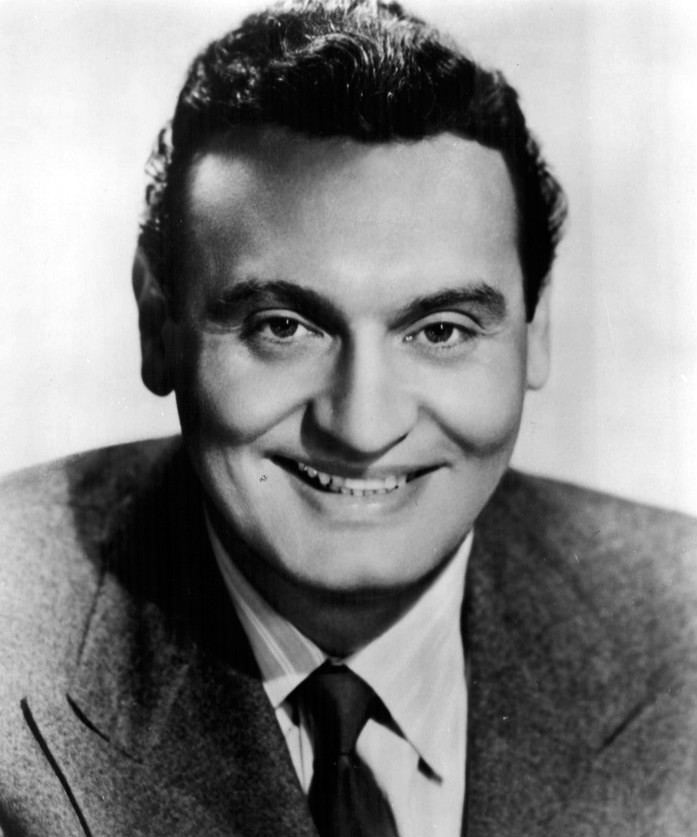
Frankie Laine (born Francesco Paolo LoVecchio; March 30, 1913 – February 6, 2007) was an American singer and songwriter whose career spanned nearly 75 years, from his first concerts in 1930 with a marathon dance company to his final performance of "That's My Desire" in 2005. Often billed as "America's Number One Song Stylist", Laine's other nicknames include "Mr. Rhythm", "Old Leather Lungs", and "Mr. Steel Tonsils". His hits included "That's My Desire", "That Lucky Old Sun", "Mule Train", "Jezebel", "High Noon", "I Believe", "Hey Joe!", "The Kid's Last Fight", "Cool Water", "Rawhide", and "You Gave Me a Mountain".
Laine sang well known theme songs for many Western film soundtracks, including 3:10 To Yuma, Gunfight at the O.K. Corral, and Blazing Saddles, although his recordings were not charted as country and western. Laine sang an eclectic variety of song styles and genres, stretching from big band crooning to pop, western-themed songs, gospel, rock, folk, jazz, and blues. He did not sing the soundtrack song for High Noon, which was sung by Tex Ritter, but his own version (with somewhat altered lyrics, omitting the name of the antagonist, Frank Miller) was the one that became a bigger hit. Laine also did not sing the theme to another show he is commonly associated with—Champion the Wonder Horse (sung by Mike Stewart)—but released his own, subsequently more popular, version.
Laine's enduring popularity was illustrated in June 2011 when a TV-advertised compilation called Hits reached No. 16 on the UK Albums Chart. The accomplishment was achieved nearly 60 years after his debut on the U.K. chart, 64 years after his first major U.S. hit and four years after his death.
Frankie Laine was born Francesco Paolo LoVecchio on March 30, 1913, to Giovanni and Crescenzia LoVecchio (née Salerno). His Cook County, Illinois, birth certificate (No. 14436) was already Americanized at the time of his birth, with his name written as "Frank Lovecchio", his mother as "Anna Salerno", and his father as "John Lovecchio", with the "V" lower case in each instance, except in the "Reported by" section with "John Lo Vecchio (father)" written in. His parents had emigrated from Monreale, Sicily, to Chicago's Near West Side, in "Little Italy", where his father worked at one time as the personal barber for gangster Al Capone. Laine's family appears to have had several organized crime connections, and young Francesco was living with his grandfather when the latter was killed by rival gangsters.
The eldest of eight children, Laine grew up in the Old Town neighborhood (first at 1446 N. North Park Avenue and later at 331 W. Schiller Street) and had his first taste of singing as a member of the choir in the Church of the Immaculate Conception's elementary school across the street from the North Park Avenue home. Laine later attended Lane Technical High School, where he helped to develop his lung power and breath control by joining the track and field and basketball teams. Laine realized he wanted to be a singer when he missed time in school to see Al Jolson's current talking picture, The Singing Fool. Jolson would later visit Laine when both were filming pictures in 1949, and around this time, Jolson remarked that Laine was going to put all the other singers out of business.
Biography summary from English Wikipedia, photograph via Wikimedia Commons.
1913
Born March 30, 1913 in United States
BIRTH
1950
Releases a first studio album, Frankie Laine Sings for Us: Songs for People Together.
MILESTONE
1954
Releases Mr. Rhythm.
MILESTONE
1956
Releases Jazz Spectacular.
MILESTONE
1958
Releases Foreign Affair.
MILESTONE
1959
Releases Reunion In Rhythm.
MILESTONE
1960
Releases You Are My Love.
MILESTONE
1962
Releases Call of the Wind.
MILESTONE
1967
Releases I Wanted Someone to Love.
MILESTONE
1968
Releases To Each His Own.
MILESTONE
1986
Releases Round‐Up.
MILESTONE
1992
Releases High Noon.
MILESTONE
1995
Releases Hitmaker!.
MILESTONE
1996
Releases The Best of Frankie Laine.
MILESTONE
1997
Releases His Greatest Hits and Finest Performances.
MILESTONE
2007
Died in 2007
IN MEMORIAM
1947
He’s Funny That Way / It Ain’t Gonna Be Like That / Old Rockin’ Chair
EP

1950
Christmas Favorites
EP
1950
Frankie Laine Sings for Us: Songs for People Together
STUDIO
1950
Music, Maestro, Please While Frankie Laine Sings
EP
1951
Sunny Side of the Street
EP
1952
Frankie Laine and Jo Stafford
EP
1953
A Musical Portrait of New Orleans
STUDIO
1953
Georgia on My Mind
EP
1954
Mr. Rhythm
STUDIO
1955
Command Performance
STUDIO
1955
I Believe / Answer Me / Strange Lady in Town / Rain, Rain, Rain
EP
1955
Tarrier Song
EP
1956
A Woman in Love
EP
1956
Four Star Selection From Guys and Dolls
EP
1956
Frankie Laine and the Four Lads
EP
1956
Frankie Laine Nº2
EP
1956
Frankie Laine Sings
EP
1956
Jazz Spectacular
STUDIO
1956
One for My Baby
STUDIO
1956
Songs by Frankie Laine
STUDIO
1956
The Voice of Your Choice
STUDIO
1958
Foreign Affair
STUDIO
1959
Balladeer
STUDIO
1959
Reunion In Rhythm
STUDIO
1959
Singing the Blues
STUDIO
1960
You Are My Love
STUDIO
1961
Hell Bent for Leather
STUDIO
1962
Call of the Wind
STUDIO
1962
Deuces Wild
STUDIO
1962
Frankie Laine Sings, Andre Previn Plays
COMPILATION
1967
I Wanted Someone to Love
STUDIO
1968
Take Me Back to Laine Country
STUDIO
1968
To Each His Own
STUDIO
1971
A Brand New Day
STUDIO
1981
Paul Anka / Frankie Laine (La grande storia del rock)
COMPILATION
1983
Frankie Laine / Johnny Ray (La grande storia del rock)
COMPILATION
1986
Round‐Up
STUDIO
1987
Frankie Laine Collection: 20 of His Best
COMPILATION
1989
16 Most Requested Songs
COMPILATION
1989
Frankie Laine & Johnnie Ray
COMPILATION
1989
Frankie Laine`s Greatest Hits
STUDIO
1991
Gunfight at the O.K. Corral
COMPILATION
1992
High Noon
STUDIO
1992
On The Trail Again
COMPILATION
1992
The Duets
STUDIO
1994
On the Trail
COMPILATION
1994
Rawhide...and More Big Hits
COMPILATION
1995
Hitmaker!
STUDIO
1995
Jezebel
STUDIO
1996
I Believe: 20 All-Time Greats
COMPILATION
1996
The Best of Frankie Laine
STUDIO
1996
The Very Best Of (ABC Years)
COMPILATION
1997
Frankie Laine
COMPILATION
1997
His Greatest Hits and Finest Performances
STUDIO
1999
High Noon: 20 Greatest Hits
COMPILATION
1999
One for My Baby & Mr. Rhythm
COMPILATION
1999
Rockin' & Hell Bent for Leather
COMPILATION
1999
The Collection
COMPILATION
2000
Cocktail Hour: Frankie Laine
COMPILATION
2000
The Platinum Collection
COMPILATION
2002
40 Great Performances
COMPILATION
2002
Gunfighter Ballads and Trail Songs
COMPILATION
2002
Rawhide
COMPILATION
2003
Foreign Affair & Reunion in Rhythm
COMPILATION
2003
Frankie Laine Sings "I Believe" and Other Great Hits
COMPILATION
2003
Moonlight Gambler
COMPILATION
2003
Torchin' & You Are My Love
COMPILATION
2004
The Frankie Laine Collection
COMPILATION
2005
50 Legendary Recordings
COMPILATION
2007
I Believe
COMPILATION
2007
That Lucky Old Sun
COMPILATION
2007
The Best of Western Movie Themes
COMPILATION
2008
Greatest Hits
COMPILATION
2011
Hits
COMPILATION
2013
Eight Classic Albums
COMPILATION
2014
The Essential Frankie Laine
COMPILATION
2019
Absolutely Christmas
COMPILATION
—
16 Greatest Hits
COMPILATION
—
20 All Time Hits
COMPILATION
—
Forever Gold
COMPILATION
—
Frankie Laine - Great Classic Songs
COMPILATION
—
Great Western Songs
COMPILATION
—
Mule Train
STUDIO
—
The Great Years
COMPILATION
—
The World of Frankie Laine
COMPILATION
Discography via MusicBrainz.
Reviews
Average rating0Based on 0 ratings
5 ★0
4 ★0
3 ★0
2 ★0
1 ★0
Log in or sign up to rate and review.
Log In / Sign UpNo reviews yet for this artist.