
IN MEMORIAM 1939 – 2018
Hugh Masekela
Cornet, Flugelhorn, Trombone, Trumpet, Vocals.
Afropop Jazz Mbaqanga
Not rated0 Fans
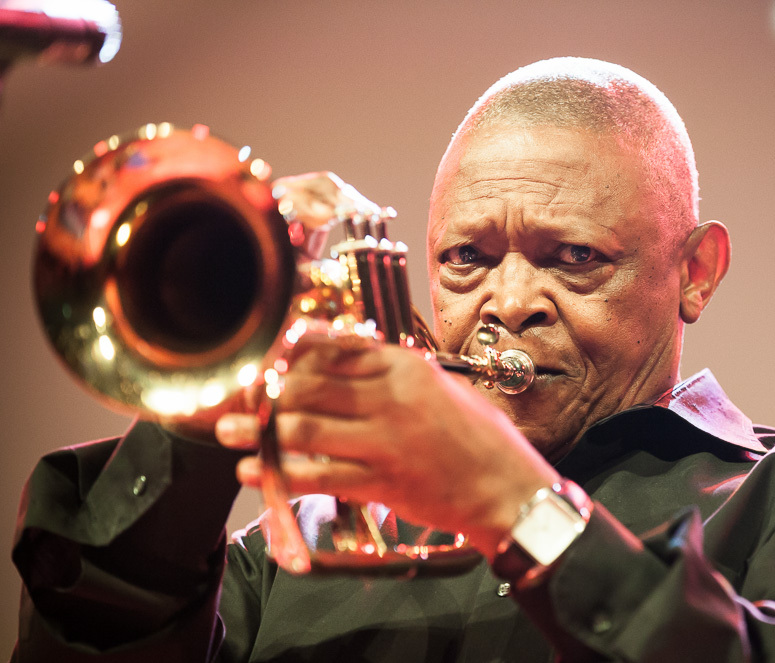
Hugh Ramapolo Masekela (4 April 1939 – 23 January 2018) was a South African trumpeter, flugelhornist, cornetist, singer and composer who was described as "the father of South African jazz". Masekela was known for his jazz compositions and for writing well-known anti-apartheid songs such as "Soweto Blues" and "Bring Him Back Home". He also had a number-one US pop hit in 1968 with the song "Grazing in the Grass", which was later covered by various other artists.
Hugh Ramapolo Masekela was born in Witbank (now called Emalahleni), South Africa, to Thomas Selema Masekela, who was a health inspector and sculptor; and his wife, Pauline Bowers Masekela, a social worker. His younger sister Barbara Masekela is a poet, educator and ANC activist. As a child, he began singing and playing piano and was largely raised by his grandmother, who ran an illegal bar for miners. At the age of 14, after seeing the 1950 film Young Man with a Horn (in which Kirk Douglas plays a character modelled on American jazz cornetist Bix Beiderbecke), Masekela took up playing the trumpet. His first trumpet was bought for him from a local music store by Archbishop Trevor Huddleston, the anti-apartheid chaplain at St. Peter's Secondary School now known as St. Martin's School (Rosettenville).
Huddleston asked the leader of the then Johannesburg "Native" Municipal Brass Band, Uncle Sauda, to teach Masekela the rudiments of trumpet playing. Masekela quickly mastered the instrument. Soon, some of his schoolmates also became interested in playing instruments, leading to the formation of the Huddleston Jazz Band, South Africa's first youth orchestra. When Louis Armstrong heard of this band from his friend Huddleston he sent one of his own trumpets as a gift for Masekela. By 1956, after leading other ensembles, Masekela joined Alfred Herbert's African Jazz Revue.
From 1954, Masekela played music that closely reflected his life experience. The agony, conflict, and exploitation faced by South Africa during the 1950s and 1960s inspired and influenced him to make music and also spread political change. In his music he portrayed the struggles and sorrows, as well as the joys and passions of his country. His music protested about apartheid, slavery, government; the hardships individuals were living. Masekela reached a large population that also felt oppressed due to the country's situation.
Following a Manhattan Brothers tour of South Africa in 1958, Masekela joined the orchestra of the musical King Kong, written by Todd Matshikiza. King Kong was South Africa's first blockbuster theatrical success, touring the country for a sold-out year with Miriam Makeba and the Manhattan Brothers' Nathan Mdledle in the lead. The musical later went to London's West End for two years.
Biography summary from English Wikipedia, photograph via Wikimedia Commons.
1939
Born April 4, 1939 in South Africa
BIRTH
1956
By 1956, after leading other ensembles, Masekela joined Alfred Herbert's African Jazz Revue.
MILESTONE
1958
Following a Manhattan Brothers tour of South Africa in 1958, Masekela joined the orchestra of the musical King Kong, written by Todd Matshikiza.
MILESTONE
1968
He also had a number-one US pop hit in 1968 with the song "Grazing in the Grass", which was later covered by various other artists.
MILESTONE
2018
Died in 2018
IN MEMORIAM
1962
Trumpet Africaine
ALBUM

1965
The Americanization of Ooga Booga
ALBUM
1966
Grrr
ALBUM
1966
Hugh Masekela's Next Album
ALBUM
1966
The Emancipation of Hugh Masekala
ALBUM
1967
Hugh Masekela’s Latest
ALBUM
1968
The Promise of a Future
ALBUM
1969
Masekela
ALBUM
1970
Reconstruction
ALBUM
1972
Home Is Where the Music Is / The African Connection
ALBUM
1973
Introducing Hedzoleh Soundz
ALBUM
1974
I Am Not Afraid
ALBUM
1975
The Boy's Doin' It
ALBUM
1976
Colonial Man
ALBUM
1977
You Told Your Mama Not to Worry
ALBUM
1978
Herb Alpert / Hugh Masekela
ALBUM
1984
Techno‐Bush
ALBUM
1985
Waiting for the Rain
ALBUM
1987
Tomorrow
ALBUM
1989
Uptownship
ALBUM
1992
Beatin’ Aroun de Bush
ALBUM
1994
Hope
ALBUM
1996
Home
ALBUM
1996
The Lasting Impressions of Ooga Booga
ALBUM
1997
Black to the Future
ALBUM
1999
Sixty
ALBUM
2002
Time
ALBUM
2005
Revival
ALBUM
2005
Almost Like Being in Jazz
ALBUM
2008
Phola
ALBUM
2010
Notes of Life
ALBUM
2012
Jabulani
ALBUM
2016
No Borders
ALBUM
2017
Johannesburg
ALBUM
2018
The Times We’ve Shared 1939–2018
ALBUM
2020
Rejoice
ALBUM
Discography via MusicBrainz.
Reviews
Average rating0Based on 0 ratings
5 ★0
4 ★0
3 ★0
2 ★0
1 ★0
Log in or sign up to rate and review.
Log In / Sign UpNo reviews yet for this artist.