
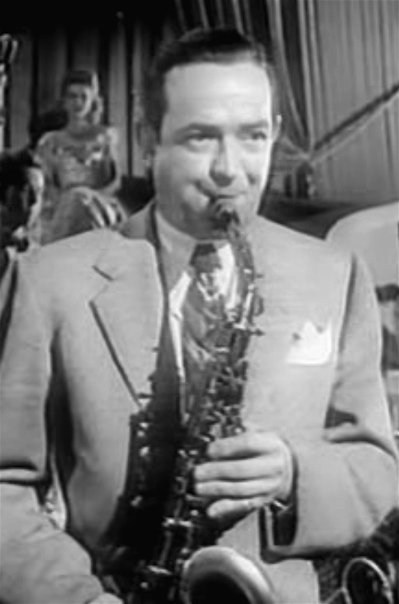
IN MEMORIAM 1904 – 1957
Jimmy Dorsey
Clarinet, Saxophone, Trumpet.
Big Band Dixieland Jazz Swing
Not rated0 Fans
James Francis Dorsey (February 29, 1904 – June 12, 1957) was an American jazz clarinetist, saxophonist, composer, and big band leader. He recorded and composed the jazz and pop standards "I'm Glad There Is You (In This World of Ordinary People)" and "It's the Dreamer in Me". His other major recordings were "Tailspin", "John Silver", "So Many Times", "Amapola", "Brazil" ("Aquarela do Brasil"), "Pennies from Heaven" (with Bing Crosby, Louis Armstrong, and Frances Langford), "Grand Central Getaway", and "So Rare". He played clarinet on the seminal jazz standards "Singin' the Blues" in 1927 and the original 1930 recording of "Georgia on My Mind", which were inducted into the Grammy Hall of Fame.
Jimmy Dorsey was born on Leap Day 1904 in Shenandoah, Pennsylvania, United States, the first son of Theresa Langton Dorsey and Thomas Francis Dorsey. His father, Thomas, was initially a coal miner, but would later become a music teacher and marching-band director. Both Jimmy and his younger brother, Tommy, were musically active during their childhoods, and by the age of seven, Jimmy was already playing with his father's band. He made his first public appearance at age nine while playing trumpet with J. Carson McGee's King Trumpeters in New York in 1913. He switched to alto saxophone in 1915 and then learned clarinet. Dorsey played an Albert system clarinet, as opposed to the more common Boehm system used by most of his contemporaries, including Benny Goodman and Artie Shaw.
With his brother Tommy on trombone, they formed Dorsey's Novelty Six, later called Dorsey's Wild Canaries, one of the first jazz bands to broadcast. In 1924, he joined the California Ramblers (based in New York City). He did much freelance radio and recording work throughout the 1920s. The brothers also appeared as session musicians on many jazz recordings. He joined Ted Lewis's band in 1930, with whom he toured Europe. The same year, he played clarinet on the iconic jazz standard "Georgia on My Mind" in 1930, with Hoagy Carmichael and His Orchestra, which featured Bix Beiderbecke on cornet. Dorsey married Jane Porter in 1928, and they had one daughter, Julia. Porter and Dorsey divorced in 1949.
During his early days as a musician, Jimmy Dorsey performed with various ensembles and artists, including the Scranton Sirens, the California Ramblers, Red Nichols, Jean Goldkette, Frankie Trumbauer, Ben Pollack, and Paul Whiteman. He played the clarinet solo on the iconic 1927 jazz standard "Singin' the Blues", with the Frankie Trumbauer Orchestra featuring Bix Beiderbecke (which would, a half-century later, be inducted into the Grammy Hall of Fame). After returning to the United States from his European tour, he worked briefly with Rudy Vallée and with several other bandleaders, and likewise with his brother Tommy—including starting their famed eponymous band. He appeared on at least seventy-five radio broadcasts, many of them with his brother. He was a member of Nat Shilkret's orchestra, on programs such as (starting in 1937) "The Music that Satisfies" (also known as the Chesterfield Quarter Hour). Glenn Miller arranged and played trombone on several early sessions that Dorsey and his brother made for OKeh Records, including "The Spell of the Blues", "Let's Do It", and "My Kinda Love"—all with Bing Crosby on vocals.
In 1927, the brothers created the Dorsey Brothers Orchestra and signed with OKeh Records. For some of their sessions, Glenn Miller would join them as trombonist, arranger, and composer, composing "Annie's Cousin Fannie", "Tomorrow's Another Day", "Harlem Chapel Chimes", and "Dese Dem Dose". Their first song to chart was "Coquette" with vocals from Bill Dutton in June, 1928. Their song, "Let's Do It (Let's Fall in Love)", with vocals by Bing Crosby, was their first to reach the top ten charts. Despite their success, the brothers frequently disagreed over management of the band and their conflict would come to a head in May 1935 when, after an onstage disagreement, Tommy stormed off. Afterward, Jimmy continued the band, keeping the Dorsey Brothers name in hopes his younger brother would return; in September 1935, the Dorsey Brothers band became "Jimmy Dorsey and His Orchestra", and he signed with Decca Records. In December, 1935 Dorsey's first song with the band, "You Let me Down", would reach the charts. For the next two years, Jimmy Dorsey and His Orchestra would provide accompaniment for Bing Crosby's Kraft Music Hall radio show. The band was featured on 73 programs, from December 1935 to July 1937; they also backed Crosby on his commercial recordings during this time. In 1936, Bing Crosby released the single "Pennies from Heaven" recorded with the Jimmy Dorsey Orchestra on Decca Records. The early band was considered more jazz-oriented than his brother's, and in response the band recorded instrumental swing classics: "Dorsey Stomp," "Tap Dancer's Nightmare," "Parade of the Milk Bottle Caps," "John Silver" and "Dusk in Upper Sandusky," and included musicians such as Bobby Byrne, Ray McKinley, Donald Matteson and Skeets Herfurt along with vocalists Bob Eberly and Kay Weber.
Biography summary from English Wikipedia, photograph via Wikimedia Commons.
1904
Born February 29, 1904 in United States
BIRTH
1924
In 1924, he joined the California Ramblers (based in New York City).
MILESTONE
1927
He played clarinet on the seminal jazz standards "Singin' the Blues" in 1927 and the original 1930 recording of "Georgia on My Mind", which were inducted into the Grammy Hall of Fame.
MILESTONE
1927
He played the clarinet solo on the iconic 1927 jazz standard "Singin' the Blues", with the Frankie Trumbauer Orchestra featuring Bix Beiderbecke (which would, a half-century later, be inducted into the Grammy Hall of…
MILESTONE
1927
In 1927, the brothers created the Dorsey Brothers Orchestra and signed with OKeh Records.
MILESTONE
1930
He joined Ted Lewis's band in 1930, with whom he toured Europe.
MILESTONE
1935
Afterward, Jimmy continued the band, keeping the Dorsey Brothers name in hopes his younger brother would return; in September 1935, the Dorsey Brothers band became "Jimmy Dorsey and His Orchestra", and he signed with…
MILESTONE
1936
In 1936, Bing Crosby released the single "Pennies from Heaven" recorded with the Jimmy Dorsey Orchestra on Decca Records.
MILESTONE
1957
Died in 1957
IN MEMORIAM
—
Shine on Harvest Moon
ALBUM

1984
Jimmy Dorsey
ALBUM
1991
Giants of the Big Band Era
ALBUM
1991
XXXIV. Tommy & Jimmy Dorsey - The Essential V-Discs
ALBUM
Discography via MusicBrainz.
Reviews
Average rating0Based on 0 ratings
5 ★0
4 ★0
3 ★0
2 ★0
1 ★0
Log in or sign up to rate and review.
Log In / Sign UpNo reviews yet for this artist.