
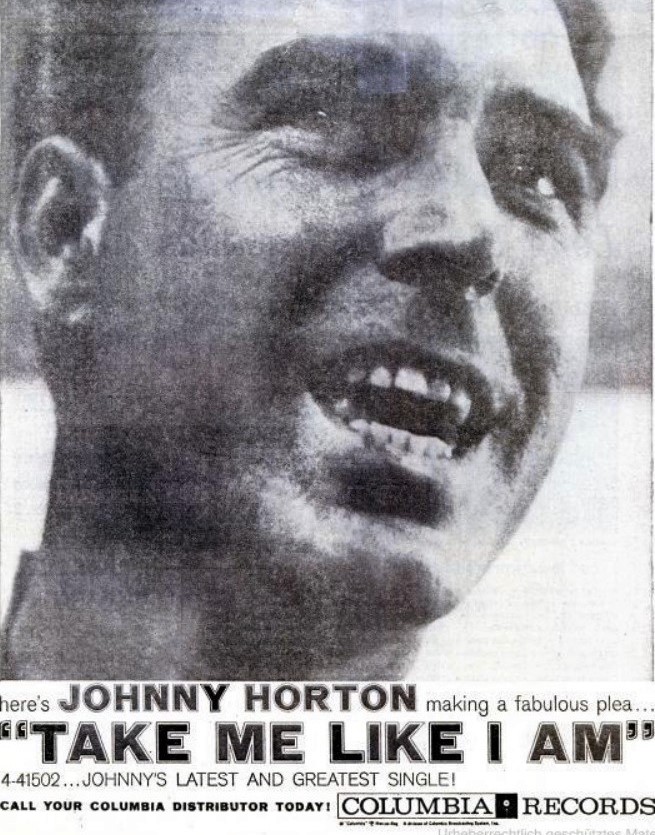
John LaGale Horton (April 30, 1925 – November 5, 1960) was an American country, honky tonk, and rockabilly musician during the 1950s. He is best known for a series of history-inspired narrative country saga songs that became international hits. His 1959 single "The Battle of New Orleans" was awarded the 1960 Grammy Award for Best Country & Western Recording. The song was awarded the Grammy Hall of Fame Award and in 2001 ranked number 333 of the Recording Industry Association of America's "Songs of the Century". His first number-one country song was in 1959, "When It's Springtime in Alaska (It's Forty Below)".
Horton had two successes in 1960 with both "Sink the Bismarck" and "North to Alaska", the latter used during the opening credits of the John Wayne film. Horton died in November 1960 at the peak of his fame in a traffic collision, less than two years after his breakthrough. He is a member of the Rockabilly Hall of Fame, the Louisiana Music Hall of Fame, and in 2025 the Texas Country Music Hall of Fame.
Horton was born on April 30, 1925, in Los Angeles, the youngest of the five children of the former Ella Claudia Robinson (1892–1966) and John Loly Horton (1889–1959), and raised in Rusk in Cherokee County in East Texas. His family often traveled between East Texas and Southern California to work as sharecroppers. After he graduated from high school in Gallatin, Texas, in 1944, Horton attended Lon Morris Junior College in Jacksonville, Texas, on a basketball scholarship. He later attended Seattle University and briefly Baylor University in Waco, although he did not graduate from any of these institutions.
Horton soon returned to California and got a job in the mail room at Selznick International Pictures, where his future wife, Donna Cook, was working in the studio as a secretary. After a short stint studying geology in Seattle in 1948, Horton went to Alaska to look for gold. During this period, he began writing songs. Returning south, he entered and won a talent contest in Henderson, Texas. Encouraged by this result, he returned to California to pursue a music career.
His guest appearances on Cliffie Stone's Hometown Jamboree on KXLA-AM and KLAC-TV in Pasadena and his own half-hour show The Singing Fisherman led to the opportunity to record some songs on the Cormac record label. By the time the company folded in 1952, Horton had recorded 10 singles for that label. Fabor Robison, owner of Abbott Records, acquired the master recordings. Around that time, Horton married Donna Cook.
Biography summary from English Wikipedia, photograph via Wikimedia Commons.
1925
Born April 30, 1925 in United States
BIRTH
1959
His 1959 single "The Battle of New Orleans" was awarded the 1960 Grammy Award for Best Country & Western Recording.
MILESTONE
1959
His first number-one country song was in 1959, "When It's Springtime in Alaska (It's Forty Below)".
MILESTONE
2001
The song was awarded the Grammy Hall of Fame Award and in 2001 ranked number 333 of the Recording Industry Association of America's "Songs of the Century".
MILESTONE
1960
Died in 1960
IN MEMORIAM
Reviews
Average rating0Based on 0 ratings
5 ★0
4 ★0
3 ★0
2 ★0
1 ★0
Log in or sign up to rate and review.
Log In / Sign UpNo reviews yet for this artist.