
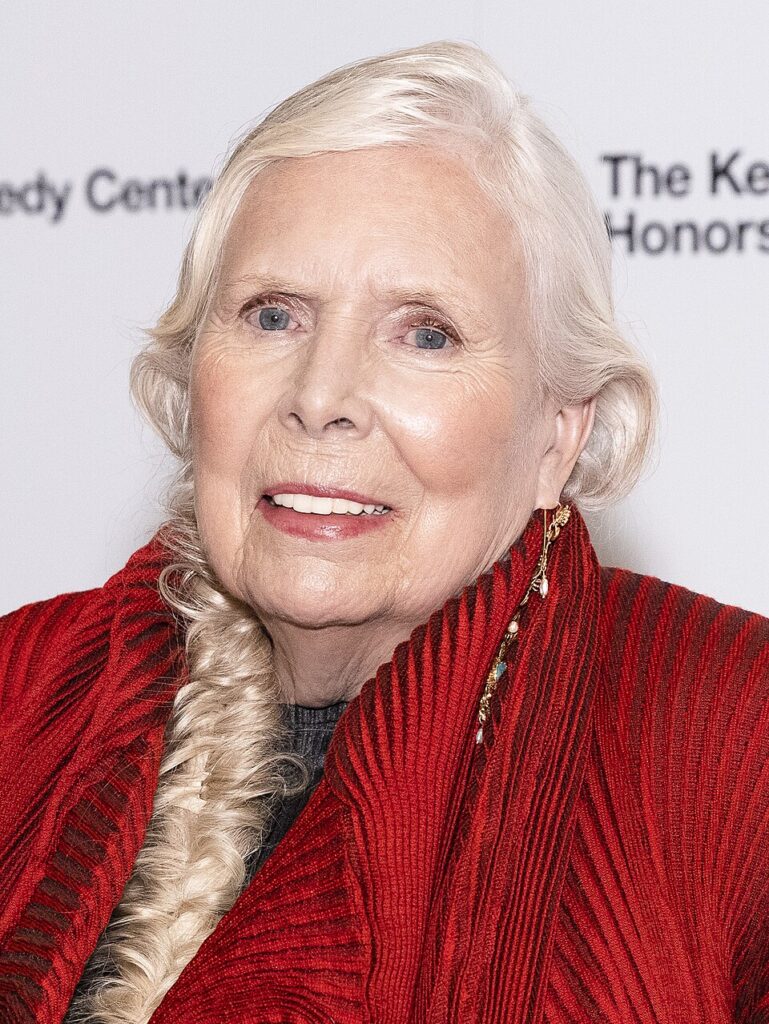
Roberta Joan Mitchell (née Anderson; born November 7, 1943) is a Canadian singer-songwriter, multi-instrumentalist, and painter. As one of the most influential singer-songwriters to emerge from the 1960s folk music circuit, Mitchell became known for her personal lyrics and unconventional compositions, which grew to incorporate elements of pop, jazz, rock, and other genres. Among her accolades are eleven Grammy Awards, and induction into the Rock and Roll Hall of Fame in 1997. Rolling Stone, in 2002, named her "one of the greatest songwriters ever", and AllMusic, in a 2011 biography, stated "Joni Mitchell may stand as the most important and influential female recording artist of the late 20th century."
Mitchell began singing in small nightclubs in Saskatoon and throughout western Canada, before moving on to the nightclubs of Toronto. She moved to the United States and began touring in 1965. Some of her original songs ("Urge for Going", "Chelsea Morning", "Both Sides, Now", "The Circle Game") were first recorded by other singers, allowing her to sign with Reprise Records and record her debut album, Song to a Seagull, in 1968. Settling in Southern California, Mitchell helped define an era and a generation with popular songs such as "Big Yellow Taxi" and "Woodstock" (both 1970). Her 1971 album Blue is often cited as one of the greatest albums of all time; it was rated the 30th best album ever made in Rolling Stone's 2003 list of the "500 Greatest Albums of All Time", rising to number 3 in the 2020 edition. In 2000, The New York Times chose Blue as one of the 25 albums that represented "turning points and pinnacles in 20th-century popular music". NPR ranked Blue number 1 on a 2017 list of the "Greatest Albums Made By Women".
Mitchell began exploring more jazz-influenced ideas on 1974's Court and Spark, which featured the radio hits "Help Me" and "Free Man in Paris" and became her best-selling album. Mitchell's vocal range began to shift from mezzo-soprano to that of a wide-ranging contralto around 1975. Her distinctive piano and open-tuned guitar compositions also grew more harmonically and rhythmically complex as she melded jazz with rock and roll, R&B, classical music and non-Western beats. Starting in the mid-1970s, she began working with noted jazz musicians including Jaco Pastorius, Tom Scott, Wayne Shorter, Herbie Hancock, and Pat Metheny as well as Charles Mingus, who asked her to collaborate on his final recordings. She later turned to pop and electronic music and engaged in political protest. She was awarded the Grammy Lifetime Achievement Award in 2002.
Mitchell produced or co-produced most of her albums and designed most of her own album covers, describing herself as a "painter derailed by circumstance". A critic of the music industry, she quit touring and released her 19th and last album of original songs in 2007. She gave occasional interviews and made appearances to speak on various causes over the next two decades, though the rupture of a brain aneurysm in 2015 led to a long period of recovery and therapy. A series of retrospective compilations were released over this time period, culminating in the Joni Mitchell Archives, a project to publish much of the unreleased material from her long career. She returned to public appearances in 2021, accepting several awards in person, including a Kennedy Center Honor. Mitchell returned to live performance with an unannounced show at the June 2022 Newport Folk Festival and has made several other appearances since, including headlining shows in 2023 and 2024.
Roberta Joan Anderson was born on November 7, 1943, in Fort Macleod, Alberta to Myrtle Marguerite (née McKee) and William Andrew Anderson. Her mother's ancestors were Scottish and Irish; her father was from a Norwegian family that may have had some Sámi ancestry, according to one family member. However, Norwegian genealogist Arnfrid Mæland disputes this claim, saying that the family tree has no Sámi lineage dating back to the 1600s. Her mother was a teacher. Her father was a Royal Canadian Air Force flight lieutenant who instructed new pilots at RCAF Station Fort Macleod. During World War II, she moved with her parents to various bases in western Canada. After the war ended, her father worked as a grocer and her family moved to Saskatchewan, living in Maidstone and North Battleford. She later sang about her small-town upbringing in several of her songs, including "Song for Sharon".
Biography summary from English Wikipedia, photograph via Wikimedia Commons.
1943
Born November 7, 1943 in Canada
BIRTH
1964–1967
Career beginnings, motherhood, and first marriage
CAREER
1968–1969
Breakthrough with Song to a Seagull and Clouds
CAREER
1970–1972
Ladies of the Canyon and Blue
CAREER
1972–1975
For the Roses and Court and Spark
CAREER
1975–1977
The Hissing of Summer Lawns and Hejira
CAREER
1977–1980
Don Juan's Reckless Daughter and Mingus
CAREER
1981–1987
Wild Things Run Fast, Dog Eat Dog, and second marriage
CAREER
1988–1993
Chalk Mark in a Rain Storm and Night Ride Home
CAREER
1994–1999
Turbulent Indigo, Taming the Tiger, and divorce
CAREER
2000–2005
Both Sides Now, retirement tour and retrospectives
CAREER
2006–2010
Shine and other late recordings
CAREER
2010–2022
Health problems, recovery, and archival projects
CAREER
1968
Song to a Seagull
ALBUM

1969
Clouds
ALBUM
1970
Ladies of the Canyon
ALBUM
1971
Blue
ALBUM
1972
For the Roses
ALBUM
1974
Court and Spark
ALBUM
1975
The Hissing of Summer Lawns
ALBUM
1976
Hejira
ALBUM
1977
Don Juan’s Reckless Daughter
ALBUM
1979
Mingus
ALBUM
1982
Wild Things Run Fast
ALBUM
1985
Dog Eat Dog
ALBUM
1988
Chalk Mark in a Rain Storm
ALBUM
1991
Night Ride Home
ALBUM
1994
Turbulent Indigo
ALBUM
1995
Live at the Fez 1995
ALBUM
1998
Taming the Tiger
ALBUM
2000
Both Sides Now
ALBUM
2002
Travelogue
ALBUM
2007
Shine
ALBUM
2021
Blue 50 (Demos & Outtakes)
EP
2023
Court And Spark Demos
ALBUM
Discography via MusicBrainz.
Reviews
Average rating0Based on 0 ratings
5 ★0
4 ★0
3 ★0
2 ★0
1 ★0
Log in or sign up to rate and review.
Log In / Sign UpNo reviews yet for this artist.
Fans
Deadikace fans who follow and made their profile public.