
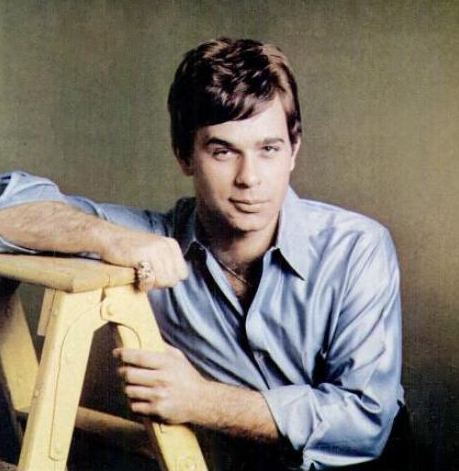
Lugee Alfredo Giovanni Sacco (February 19, 1943 – June 18, 2025), known professionally by his stage name Lou Christie, was an American pop and soft rock singer-songwriter widely known for hits in the 1960s, including his 1966 U.S. chart-topper "Lightnin' Strikes" and 1969 UK number two hit "I'm Gonna Make You Mine".
Christie was born Lugee Alfredo Giovanni Sacco on February 19, 1943, in Glenwillard, Pennsylvania, and grew up in suburban Pittsburgh. While attending Moon Area High School, he studied music and voice, served as student conductor of the choir and sang solos at holiday concerts. His teacher, Frank Cummings, wanted him to pursue a career in classical music, but Sacco wanted to cut a record to get on American Bandstand. At age 15, he met and befriended Twyla Herbert, a classically trained musician 20 years his senior, who became his regular songwriting partner and wrote hundreds of songs with him over the next 30 years until her death in 2009. Sacco performed with several vocal groups and between 1959 and 1962 released several records on small Pittsburgh labels, achieving a local hit with "The Jury" by Lugee & The Lions (a group consisting of Sacco, Twyla Herbert's daughter Shirley, and two others) released on the Robbee label. After graduating from high school in 1961, Sacco traveled to New York City and worked as a session vocalist.
In 1962, Sacco approached Nick Cenci with some demo tapes. One of the first things Cenci did was change the name Lugee Alfredo Giovanni Sacco to Lou Christie. Sacco's father liked the name change, because it had "Christ" in it. The singer himself did not like the name, though he was open to using a stage name and was compiling a list of suggestions before Cenci unilaterally picked "Lou Christie" without asking him; he later recalled it taking him 20 years to get used to it.
Cenci liked Sacco's falsetto voice and suggested that he listen to the Four Seasons' recent hit "Sherry". Sacco and Herbert used the song as a model to write an original song called "The Gypsy Cried". (Christie did not acknowledge any inspiration from The Four Seasons in interviews, noting that he strove not to sound like other recording artists.) Cenci produced a recording of Sacco performing the song at Gateway Studio in Pittsburgh and initially released it on his own C & C label as a single in 1962, credited to "Lou Christie", the name Sacco used thereafter.
"The Gypsy Cried" became a regional hit, selling 30,000 copies in Pittsburgh. Cenci contacted Morris Levy of Roulette Records, saying that he had a hit that needed national distribution. Levy released the single on Roulette, but initially nothing happened. Airplay slowly spread across the country, and "The Gypsy Cried" reached No. 24 on the Billboard Hot 100 chart, selling over one million copies. Cenci produced additional recording sessions for Christie in 1963 that generated two more hits. "Two Faces Have I", his second million-seller, reached No. 6 on the chart in June 1963. Roulette also released Christie's self-titled LP (where "The Gypsy Cried" and "Two Faces Have I" are included), which reached No. 124 on the Billboard 200. With those hits, Christie joined Dick Clark's Caravan of Stars Tour, alongside Diana Ross, Brian Hyland, and others.
Biography summary from English Wikipedia, photograph via Wikimedia Commons.
1943
Born February 19, 1943 in United States
BIRTH
1959
Sacco performed with several vocal groups and between 1959 and 1962 released several records on small Pittsburgh labels, achieving a local hit with "The Jury" by Lugee & The Lions (a group consisting of…
MILESTONE
1962
(Christie did not acknowledge any inspiration from The Four Seasons in interviews, noting that he strove not to sound like other recording artists.) Cenci produced a recording of Sacco performing the song at Gateway…
MILESTONE
2025
Died in 2025
IN MEMORIAM
1963
Lou Christie
ALBUM

1965
Lightnin' Strikes
ALBUM
1966
Painter of Hits
ALBUM
1966
Strikes Back
ALBUM
1966
Lou Christie Strikes Again
ALBUM
1969
I'm Gonna Make You Mine
ALBUM
1971
Paint America Love
ALBUM
1974
Lou Christie
ALBUM
1982
Lou Christie Does Detroit!
ALBUM
Discography via MusicBrainz.
Reviews
Average rating0Based on 0 ratings
5 ★0
4 ★0
3 ★0
2 ★0
1 ★0
Log in or sign up to rate and review.
Log In / Sign UpNo reviews yet for this artist.