
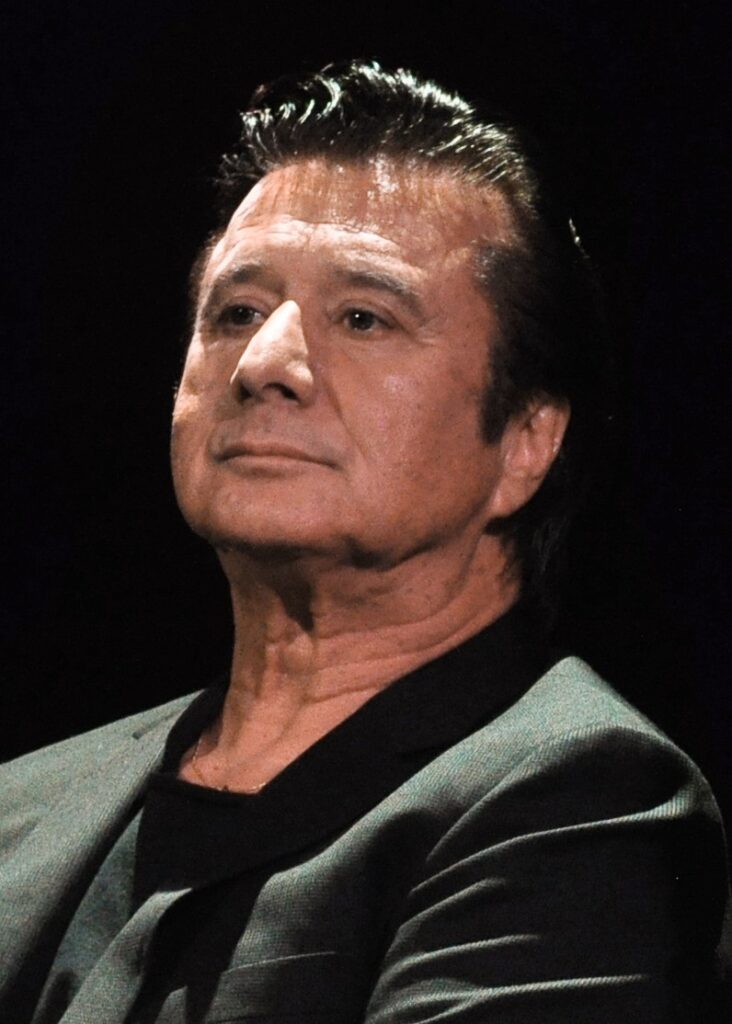
Stephen Ray Perry (born January 22, 1949) is an American singer and songwriter. He was the lead singer and frontman of the rock band Journey during their most successful years from 1977 to 1987, and again from 1995 to 1998. He wrote or co-wrote several Journey hit songs, including "Any Way You Want It", "Don't Stop Believin'", "Open Arms", "Who's Crying Now", "Faithfully" and "Separate Ways (Worlds Apart)". Perry had a solo career from the mid-1980s to the mid-1990s, made sporadic appearances in the 2000s, and returned to music full-time in 2018.
Perry's singing voice has garnered acclaim from prominent musical peers and publications; he has been dubbed "The Voice", a moniker originally coined by Jon Bon Jovi. Ranked No. 76 on Rolling Stone's "100 Greatest Singers of All Time", Perry was inducted into the Rock and Roll Hall of Fame as a member of Journey in 2017. In August 2023, Perry made the Billboard list of the 50 greatest rock lead singers of all time, at number 30. At the same time, Billboard readers chose Perry as their favorite rock singer of all time, with 67 percent of the overall votes.
Stephen Ray Perry was born in Hanford, California to Portuguese parents from the Azores. He is an only child. Perry grew up interested in music, as his father, Raymond Perry (Pereira), was a vocalist and co-owner of radio station KNGS. Perry's parents ended their relationship when he was eight. He and his mother then moved to his grandparents' dairy farm. They lived in Lemoore, where he attended high school.
On Perry's 12th birthday, his mother, Mary Quaresma, presented him with a gold eighth note pendant; Perry wears the pendant for good luck. At age 12, Perry heard Sam Cooke's song "Cupid" on his mother's car radio; it inspired him to become a singer.
In his early 20s, Perry moved to Sacramento to start a band, later named Ice, with 16-year-old future music producer Scott Mathews, who co-wrote, played drums and guitar and sang. In 1972, they recorded at the Record Plant studios in Los Angeles by day while Stevie Wonder recorded his Talking Book album by night. Upon returning to Sacramento, Ice disbanded as they had no management, Mathews was still in high school, and the recordings went virtually unheard. In 1975, Perry moved to Thousand Oaks, California, where he formed a progressive rock band called Pieces with Tim Bogert (who had previously worked with Jeff Beck), Denver Cross, and Eddie Tuduri. After a year and a half, the group was unable to secure a record deal and disbanded. Perry also unsuccessfully auditioned to replace Rod Evans in Captain Beyond.
Biography summary from English Wikipedia, photograph via Wikimedia Commons.
1949
Born January 22, 1949 in United States
BIRTH
1972
In 1972, they recorded at the Record Plant studios in Los Angeles by day while Stevie Wonder recorded his Talking Book album by night.
MILESTONE
1975
In 1975, Perry moved to Thousand Oaks, California, where he formed a progressive rock band called Pieces with Tim Bogert (who had previously worked with Jeff Beck), Denver Cross, and Eddie Tuduri.
MILESTONE
2017
76 on Rolling Stone's "100 Greatest Singers of All Time", Perry was inducted into the Rock and Roll Hall of Fame as a member of Journey in 2017.
MILESTONE
2018
Perry had a solo career from the mid-1980s to the mid-1990s, made sporadic appearances in the 2000s, and returned to music full-time in 2018.
MILESTONE
—
Member of Journey
BAND
Reviews
Average rating0Based on 0 ratings
5 ★0
4 ★0
3 ★0
2 ★0
1 ★0
Log in or sign up to rate and review.
Log In / Sign UpNo reviews yet for this artist.