
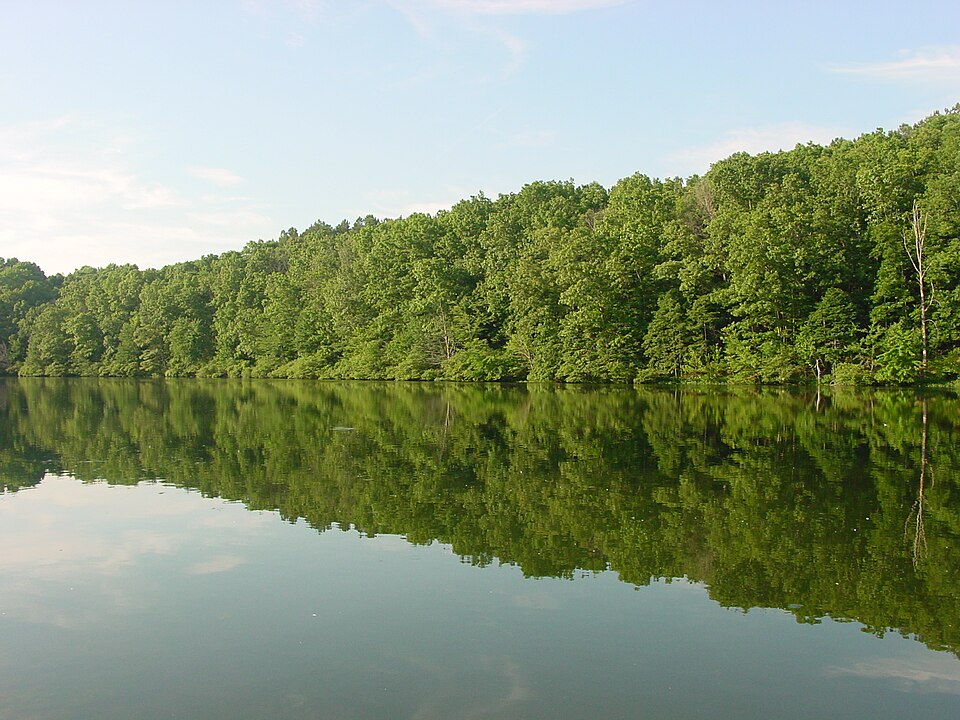
Tennessee (/ˌtɛnɪˈsiː/ ⓘ, .mw-parser-output .IPA-label-small{font-size:85%}.mw-parser-output .references .IPA-label-small,.mw-parser-output .infobox .IPA-label-small,.mw-parser-output .navbox .IPA-label-small{font-size:100%}locally /ˈtɛnɪsi/), officially the State of Tennessee, is a landlocked state in the Southeastern region of the United States. It borders Kentucky to the north, Virginia to the northeast, North Carolina to the east, Georgia, Alabama, and Mississippi to the south, Arkansas to the southwest, and Missouri to the northwest. Tennessee is the 36th-largest by area and the 15th-most populous of the 50 states. According to the United States Census Bureau, the state's estimated population as of 2024 is 7.22 million.
Tennessee is geographically, culturally, and legally divided into three Grand Divisions of East, Middle, and West Tennessee. Nashville is the state's capital and most populous city, and anchors its largest metropolitan area. Tennessee has diverse terrain and landforms, and from east to west, contains a mix of cultural features characteristic of Appalachia, the Upland South, and the Deep South. The Blue Ridge Mountains along the eastern border reach some of the highest elevations in eastern North America, and the Cumberland Plateau contains many scenic valleys and waterfalls. The central part of the state is marked by cavernous bedrock and irregular rolling hills, and level, fertile plains define West Tennessee. The state is twice bisected by the Tennessee River, and the Mississippi River forms its western border. The Great Smoky Mountains National Park, the nation's most visited national park, is in eastern Tennessee.
Tennessee is rooted in the Watauga Association, a 1772 frontier pact generally regarded as the first constitutional government west of the Appalachian Mountains. Its name derives from Tanasi (ᏔᎾᏏ), a Cherokee town preceding the first European American settlement. Tennessee was initially part of North Carolina, and later the Southwest Territory, before its admission to the Union as the 16th state on June 1, 1796. It earned the nickname "The Volunteer State" due to a strong tradition of military service. A slave state until the American Civil War, Tennessee was politically divided, with most of its western and middle parts supporting the Confederacy, and most of the eastern region harboring pro-Union sentiment. As a result, Tennessee was the last state to officially secede from the Union and join the Confederacy, and the first former Confederate state readmitted to the Union after the war had ended during the Reconstruction era.
During the 20th century, Tennessee transitioned from a predominantly agrarian society to a more diversified economy. This was aided in part by massive federal investment in the Tennessee Valley Authority (TVA) and the city of Oak Ridge, which was established during World War II to house the Manhattan Project's uranium enrichment facilities for the construction of the world's first atomic bombs. After the war, the Oak Ridge National Laboratory became a key center of scientific research. The state's economy is dominated by the health care, music, finance, automotive, chemical, electronics, and tourism sectors, and cattle, soybeans, poultry, corn, and cotton are its primary agricultural products. Tennessee has played a major role in the development of many forms of popular music, including country, blues, rock and roll, soul, and gospel.
Tennessee derives its name most directly from the Cherokee town of Tanasi (or "Tanase", in syllabary: ᏔᎾᏏ) in present-day Monroe County, Tennessee, on the Tanasi River, now known as the Little Tennessee River. In 1567, Spanish explorer Captain Juan Pardo and his party encountered a Native American village named "Tanasqui" in the area while traveling inland from modern-day South Carolina; however, it is unknown if this was the same settlement as Tanasi. The town appeared on British maps as early as 1725. Recent research suggests that the Cherokees adapted the name from the Yuchi word Tana-tsee-dgee, meaning "brother-waters-place" or "where-the-waters-meet". The modern spelling, Tennessee, is attributed to Governor James Glen of South Carolina, who used this spelling in his official correspondence during the 1750s. In 1788, North Carolina created "Tennessee County", and in 1796, a constitutional convention, organizing the new state from the Southwest Territory, adopted "Tennessee" as the state's name.
Biography summary from English Wikipedia, photograph via Wikimedia Commons.
1919
Born February 13, 1919
BIRTH
1991
Died in 1991
IN MEMORIAM
Reviews
Average rating0Based on 0 ratings
5 ★0
4 ★0
3 ★0
2 ★0
1 ★0
Log in or sign up to rate and review.
Log In / Sign UpNo reviews yet for this artist.