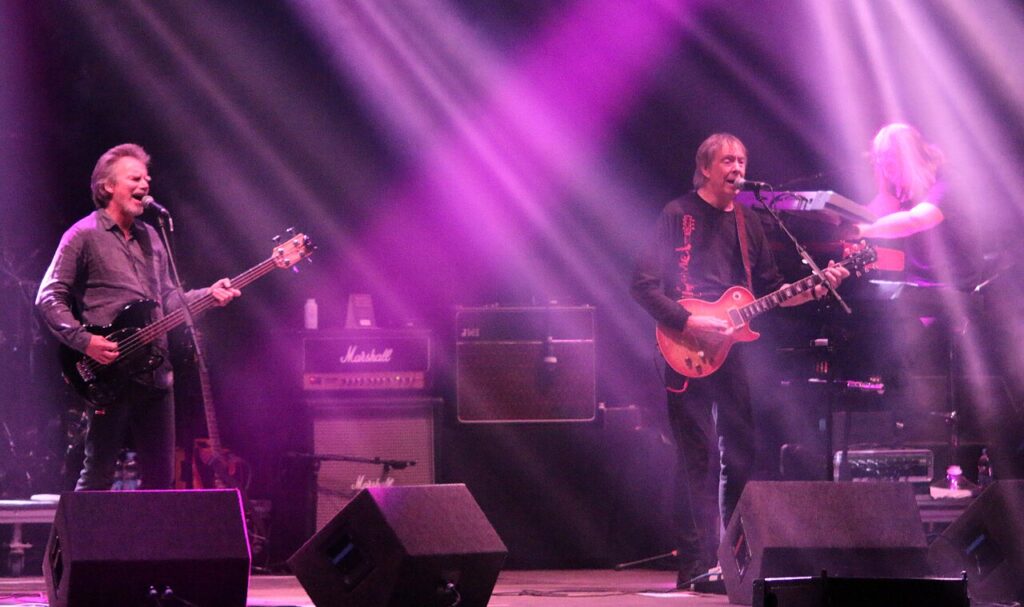
Camel are an English progressive rock band formed in Guildford, Surrey, in 1971. Led by guitarist Andrew Latimer, they have released fourteen studio albums and fourteen singles, plus numerous live albums and DVDs. Without achieving mass popularity, the band gained a cult following in the 1970s with albums such as Mirage (1974), The Snow Goose (1975) and Moonmadness (1976). They moved into a jazzier, more commercial direction in the early 1980s, but then went on an extended hiatus. Since 1991 the band has been independent, releasing albums on their own label.Despite no new studio releases since 2002, the band are still (as of 2025) occasionally performing live. Their music has influenced artists including Marillion, Opeth and Steven Wilson. Music journalist Mark Blake described Camel as "the great unsung heroes of 70s prog rock".The band was formed in Guildford, Surrey, in 1971 by guitarist Andrew Latimer, drummer Andy Ward, bassist Doug Ferguson and keyboardist Peter Bardens. Latimer, Ward, and Ferguson had performed in the Guildford area as a trio named Brew, and in 1971 they auditioned to be the backing band for singer-songwriter Phillip Goodhand-Tait. The three went on to appear on latter's album I Think I'll Write a Song, released in September 1971. After splitting with Goodhand-Tait, the trio decided that a keyboardist would expand their sound and advertised for one in the Melody Maker. Bardens responded and successfully auditioned with a Hammond organ that belonged to a mutual friend of the group. The four travelled to Ireland to fulfil outstanding contractual obligations Bardens had with his previous outfit On, after which they renamed themselves Camel. Their live debut with the name followed at Waltham Forest Technical College in London in December 1971, supporting Wishbone Ash.The group began regular touring in January 1972, establishing themselves as a proficient live act. They soon signed with Geoff Jukes of the Buffalo Agency as their manager. By August 1972, Camel signed with MCA Records and their eponymous debut album Camel was released in early 1973. The record was not a success and the band moved to the Deram Records division of Decca Records (UK). In 1974 they released their second album, the critically acclaimed Mirage, on which Latimer showed he was also adept on flute. Although failing to chart at home, it gained success in the United States, prompting a three-month tour there.Released in 1975, the instrumental concept album The Snow Goose, inspired by the Paul Gallico short story of the same name, was the breakthrough album that brought Camel wider attention and success. However, the album attracted a lawsuit from Gallico. It is often reported that Gallico brought the suit because he "loathed smoking" and thought the band were related to the cigarette brand. In reality Gallico described himself as "an addict of the vice in all its blackest forms" and his objection was simply on the grounds of copyright infringement. Camel accordingly added the prefix Music inspired by... to the album's front cover and removed the story notes from the back cover. The album's success led to a prestigious appearance at Royal Albert Hall with the London Symphony Orchestra in October 1975. By the end of the year, the band were voted Britain's Brightest Hope in the annual Melody Maker readers' poll.
Biography summary from English Wikipedia, photograph via Wikimedia Commons.
1971Camel are an English progressive rock band formed in Guildford, Surrey, in 1971.MILESTONE
1971The band was formed in Guildford, Surrey, in 1971 by guitarist Andrew Latimer, drummer Andy Ward, bassist Doug Ferguson and keyboardist Peter Bardens.MILESTONE
1971The three went on to appear on latter's album I Think I'll Write a Song, released in September 1971.MILESTONE
1971Their live debut with the name followed at Waltham Forest Technical College in London in December 1971, supporting Wishbone Ash.MILESTONE
1972By August 1972, Camel signed with MCA Records and their eponymous debut album Camel was released in early 1973.MILESTONE
1974In 1974 they released their second album, the critically acclaimed Mirage, on which Latimer showed he was also adept on flute.MILESTONE
1975Released in 1975, the instrumental concept album The Snow Goose, inspired by the Paul Gallico short story of the same name, was the breakthrough album that brought Camel wider attention and success.MILESTONE
1975The album's success led to a prestigious appearance at Royal Albert Hall with the London Symphony Orchestra in October 1975.MILESTONE
—
Peter Bardens
CURRENT MEMBER
1973
Camel
ALBUM

1974
Mirage
ALBUM
1975
The Snow Goose
ALBUM
1976
Moonmadness
ALBUM
1977
Rain Dances
ALBUM
1977
In Concert-159
LIVE
1978
Breathless
ALBUM
1978
A Live Record
LIVE
1979
I Can See Your House From Here
ALBUM
1980
Kosei Nenkin Hall, Tokyo, January 27, 1980
LIVE
1981
Nude
ALBUM
1982
The Single Factor
ALBUM
1984
Pressure Points
LIVE
1984
Stationary Traveller
ALBUM
1985
A Compact Compilation
COMPILATION
1985
The Collection
COMPILATION
1991
Dust and Dreams
ALBUM
1991
Landscapes
COMPILATION
1992
On the Road 1972
LIVE
1993
Never Let Go
LIVE
1993
Echoes
COMPILATION
1994
On the Road 1982
LIVE
1996
Harbour of Tears
ALBUM
1997
On the Road 1981
LIVE
1997
Camel
COMPILATION
1998
Coming of Age
LIVE
1999
Rajaz
ALBUM
2000
’73–’75: Gods of Light
LIVE
2001
Lunar Sea: An Anthology 1973–1985
COMPILATION
2001
The Paris Collection
LIVE
2002
A Nod and a Wink
ALBUM
2003
Another Night
LIVE
2006
Best: Supertwister
COMPILATION
2010
Rainbow’s End: An Anthology 1973–1985
COMPILATION
2013
The Snow Goose
ALBUM
2019
Live In Tokyo '79 & '80
ALBUM
2019
Live in Concert, London '77
LIVE
2019
Live in London & New York '74
LIVE
2020
Live at the Royal Albert Hall
LIVE
2021
Chameleon - The Best Of Camel
COMPILATION
2023
Air Born (The MCA & Decca Years 1973–1984)
COMPILATION
2023
The Live Recordings 1974 – 1977
COMPILATION
2026
Earthrise - Live At The Marquee 1974
LIVE
—
Driving
LIVE
—
Golders Green 1977
LIVE
—
Hammersmith Odeon 1977
LIVE
—
Live In Concert, London '77
LIVE
—
Live in Poland '97
LIVE
—
Live in Warschau 1997
LIVE
—
Marquee Club
LIVE
—
Rajaz / Stationary Traveller
COMPILATION
—
The Stationary Tour: Live at Vredenburg
LIVE
—
Unevensongs
LIVE
Discography via MusicBrainz.
Reviews
Average rating5Based on 1 rating
5 ★1
4 ★0
3 ★0
2 ★0
1 ★0
Log in or sign up to rate and review.
Log In / Sign Up1 rating so far, and no written review yet. Yours could be the first.
Fans
Deadikace fans who follow and made their profile public.