
BAND PROFILE 1967–2022
Genesis
United Kingdom
Progressive rockart rockpop rocksoft rock
Not rated0 Fans
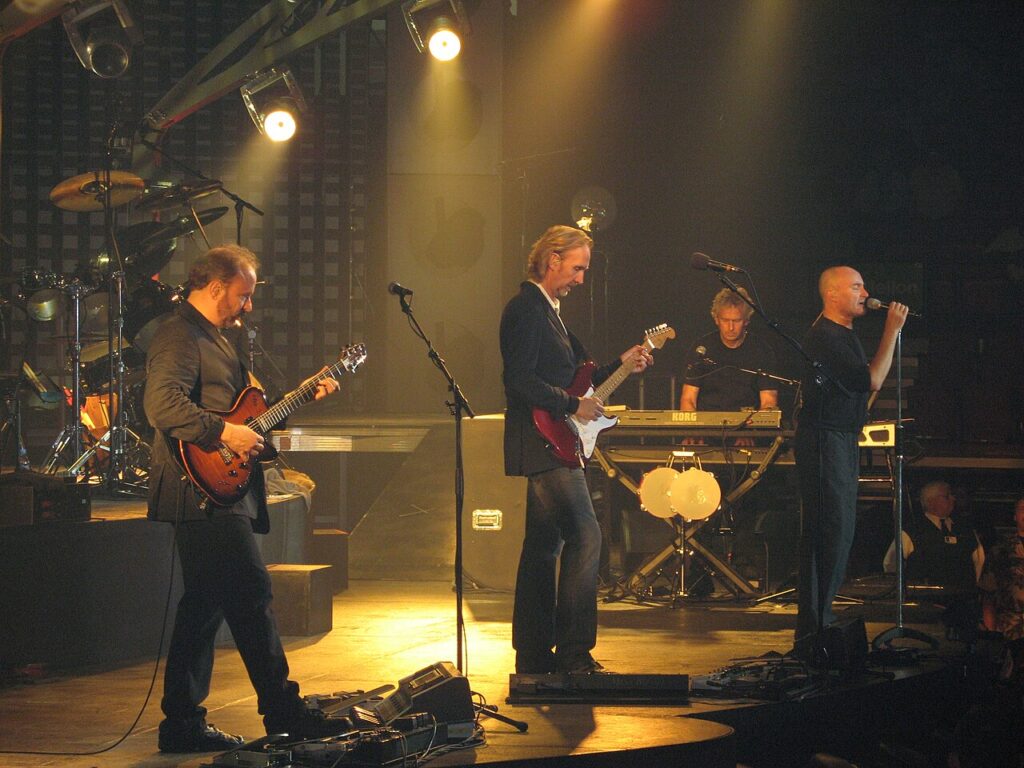
Genesis were an English rock band formed in 1967 at Charterhouse School in Godalming, Surrey. The band's longest-lasting and most commercially successful line-up consisted of keyboardist Tony Banks, bassist/guitarist Mike Rutherford and drummer/singer Phil Collins. In the 1970s, during which the band also included singer Peter Gabriel and guitarist Steve Hackett, Genesis were among the pioneers of progressive rock. Banks and Rutherford were the only constant members throughout the band's history.The band was formed by Charterhouse pupils Banks, Rutherford, Gabriel, guitarist Anthony Phillips, and drummer Chris Stewart and were named by pop impresario and alumnus Jonathan King, who arranged the recording of several singles and their debut album From Genesis to Revelation (1969). After splitting from King, the band began touring, signed with Charisma Records, and shifted to progressive rock with their next album Trespass (1970). Phillips left the band and Banks, Rutherford and Gabriel recruited Collins and Hackett before recording Nursery Cryme (1971). Their live shows subsequently gained notoriety for Gabriel's theatrical costumes and performances. Foxtrot (1972) was their first charting album in the UK, while Selling England by the Pound (1973) reached number three and featured their first UK hit single, "I Know What I Like (In Your Wardrobe)". Gabriel left the group following a transatlantic tour for their concept double album, The Lamb Lies Down on Broadway (1974).Collins took over as lead singer and, as a four-piece, the group released A Trick of the Tail and Wind & Wuthering (both 1976) with continued success. Hackett left the band in 1977, reducing the group to a three-piece of Banks, Rutherford and Collins. Their ninth studio album, ...And Then There Were Three... (1978), contained the band's first major hit, "Follow You Follow Me". Their next five studio albums – Duke (1980), Abacab (1981), Genesis (1983), Invisible Touch (1986) and We Can't Dance (1991) – saw the band embracing a more pop-oriented sound and achieving massive commercial success. Collins left Genesis in 1996 and was replaced by singer Ray Wilson for their final studio album, Calling All Stations (1997). Disappointing reception led the group to disband until Banks, Rutherford and Collins reunited for the Turn It On Again Tour in 2007 and The Last Domino? Tour in 2021.With 100 million to 150 million albums sold worldwide, Genesis rank among the world's best-selling music artists. Their discography spans fifteen studio and six live albums. They won numerous accolades, including a Grammy Award for Best Concept Music Video for "Land of Confusion", and were inducted into the Rock and Roll Hall of Fame in 2010. They inspired numerous tribute acts recreating stage shows from different eras of the band's career.The founding members of Genesis, Peter Gabriel, Tony Banks, Anthony "Ant" Phillips, Mike Rutherford and drummer Chris Stewart, met at Charterhouse School, a public school in Godalming, Surrey. Banks and Gabriel arrived at the school in September 1963, Rutherford in September 1964 and Phillips in April 1965. The five were members in either one of the school's two bands; Phillips and Rutherford were in Anon with singer Richard Macphail, bassist Rivers Jobe and drummer Rob Tyrrell, while Gabriel, Banks and Stewart made up Garden Wall.
Biography summary from English Wikipedia, photograph via Wikimedia Commons.
1967–1969Formation, early demos and From Genesis to RevelationCAREER
1969–1970First gigs, signing with Charisma, Trespass and Phillips' departureCAREER
1970–1972Collins and Hackett join and Nursery CrymeCAREER
1972–1974Foxtrot and Selling England by the PoundCAREER
1974–1975The Lamb Lies Down on Broadway and Gabriel's departureCAREER
1975–1977Collins becomes frontman, A Trick of the Tail, Wind & Wuthering and Hackett's departureCAREER
1977–1980...And Then There Were Three... and DukeCAREER
1980–1985Abacab and GenesisCAREER
1985–1996Invisible Touch, We Can't Dance and Collins' departureCAREER
1996–2006Wilson as frontman, Calling All Stations and hiatusCAREER
2006–2020Turn It On Again Tour, BBC documentary and reunion speculationCAREER
2020–2022The Last Domino? TourCAREER
—
Tony Banks
CURRENT MEMBER
—
Peter Gabriel
CURRENT MEMBER
—
Mike Rutherford
CURRENT MEMBER
—
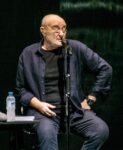
Phil Collins
CURRENT MEMBER
—
Anthony Phillips — left 1970
PAST MEMBER
—
Steve Hackett
CURRENT MEMBER
—
Ray Wilson
CURRENT MEMBER
—
Daryl Stuermer
CURRENT MEMBER
—
Chester Thompson
CURRENT MEMBER
—
Bill Bruford
CURRENT MEMBER
1969
From Genesis to Revelation
ALBUM

1970
Trespass
ALBUM
1971
Nursery Cryme
ALBUM
1972
Foxtrot
ALBUM
1973
Selling England by the Pound
ALBUM
1973
70’s Pop Sound
COMPILATION
1973
Live
LIVE
1974
The Lamb Lies Down on Broadway
ALBUM
1975
Rock Theatre
COMPILATION
1976
Wind & Wuthering
ALBUM
1976
A Trick of the Tail
ALBUM
1977
Seconds Out
LIVE
1978
The Story of Genesis
COMPILATION
1978
…And Then There Were Three…
ALBUM
1980
Duke
ALBUM
1981
Abacab
ALBUM
1982
Three Sides Live
LIVE
1983
Genesis
ALBUM
1985
The Mama Tour
LIVE
1986
Invisible Touch
ALBUM
1988
Invisible Touch Tour
LIVE
1990
Trespass / Nursery Cryme / Foxtrot
COMPILATION
1990
The Vertigo Years
COMPILATION
1991
We Can’t Dance
ALBUM
1991
Selling England by the Pound / The Lamb Lies Down on Broadway I & II
COMPILATION
1991
Turn It On Again: Best of ’81–’83
COMPILATION
1992
The Way We Walk, Volume 1: The Shorts
LIVE
1992
In Concert 1976
LIVE
1993
The Way We Walk, Volume 2: The Longs
LIVE
1994
Mega
COMPILATION
1997
…Calling All Stations…
ALBUM
1998
Live / The Way We Walk
COMPILATION
1998
Archive 1967–75
COMPILATION
1999
Turn It On Again: The Hits
COMPILATION
2000
Archive #2 1976–1992
COMPILATION
2001
The Way We Walk: Live in Concert
LIVE
2002
It’s Only Knock and Knowall
COMPILATION
2004
The Video Show
COMPILATION
2004
Platinum Collection
COMPILATION
2004
Live
LIVE
2007
Ottawa, ON 09·15·07
LIVE
2007
Düsseldorf, DE 27·06·07
LIVE
2007
Montreal, QC 09·14·07
LIVE
2007
Munich, DE 10·07·07
LIVE
2007
Buffalo, NY 09·08·07
LIVE
2007
Berne, CH 17·06·07
LIVE
2007
Detroit, MI 09·30·07
LIVE
2007
Düsseldorf, DE 26·06·07
LIVE
2007
Chicago, IL 10·04·07
LIVE
2007
Manchester, UK 07·07·07
LIVE
2007
Philadelphia, PA 09·20·07
LIVE
2007
Extra Tracks 1976–1982
COMPILATION
2007
Berlin, DE 03·07·07
LIVE
2007
Chicago, IL 10·03·07
LIVE
2007
Stuttgart, DE 28·06·07
LIVE
2007
Hannover, DE 23·06·07
LIVE
2007
1976–1982
COMPILATION
2007
Pittsburgh, PA 09·09·07
LIVE
2007
Chicago, IL 10·02·07
LIVE
2007
East Rutherford, NJ 09·27·07
LIVE
2007
Helsinki, FI 11·06·07
LIVE
2007
14 From Our Past
COMPILATION
2007
Cleveland, OH 09·29·07
LIVE
2007
London, UK 08·07·07
LIVE
2007
Albany, NY 09·12·07
LIVE
2007
Boston, MA 09·11·07
LIVE
2007
Paris, FR 30·06·07
LIVE
2007
Herning, DK 14·06·07
LIVE
2007
Frankfurt, DE 05·07·07
LIVE
2007
Lyon, FR 12·07·07
LIVE
2007
Leipzig, DE 04·07·07
LIVE
2007
Brussels, BE 24·06·07
LIVE
2007
Hartford, CT 09·16·07
LIVE
2007
Katowice, PL 21·06·07
LIVE
2007
Sacramento, CA 10·10·07
LIVE
2007
1983–1998
COMPILATION
2007
Denver, CO 10·06·07
LIVE
2007
Toronto, ON 09·07·07
LIVE
2007
Hamburg, DE 15·06·07
LIVE
2007
Prague, CZ 20·06·07
LIVE
2007
Philadelphia, PA 09·18·07
LIVE
2007
Linz, AT 19·06·07
LIVE
2007
Live Over Europe 2007
LIVE
2007
Hollywood, CA 10·12·07
LIVE
2007
Rome, IT 14·07·07
LIVE
2007
New York, NY 09·25·07
LIVE
2007
Columbus, OH 09·22·07
LIVE
2007
Hollywood, CA 10·13·07
LIVE
2007
Pittsburgh, PA 09·09·07
LIVE
2007
Philadelphia, PA 09·19·07
LIVE
2007
San Jose, CA 10·09·07
LIVE
2007
Amsterdam, NL 01·07·07
LIVE
2008
The Early Days of Genesis
COMPILATION
2008
1970–1975
COMPILATION
2009
Live 1973–2007
COMPILATION
2014
R‐Kive
COMPILATION
2017
50 Years Ago
COMPILATION
2021
The Last Domino?
COMPILATION
2022
Ten Songs for You
COMPILATION
2023
BBC Broadcasts
COMPILATION
Discography via MusicBrainz.
Reviews
Average rating0Based on 0 ratings
5 ★0
4 ★0
3 ★0
2 ★0
1 ★0
Log in or sign up to rate and review.
Log In / Sign UpNo reviews yet for this band.