
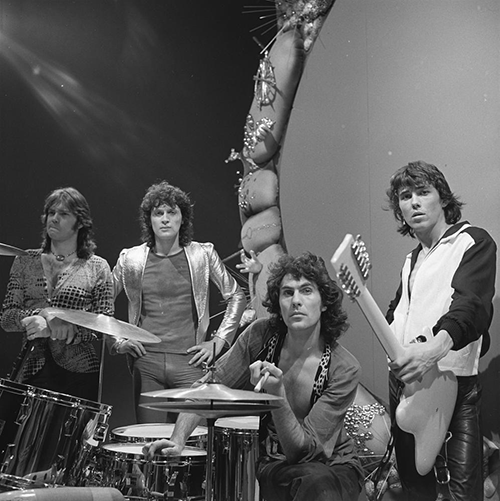
BAND PROFILE 1961–2021
Golden Earring
Netherlands
Hard rockblues rockjazz rockpsychedelic rockgarage rock
Not rated0 Fans
Golden Earring were a Dutch rock band, founded in 1961 in The Hague as the Tornados. They achieved worldwide fame with their songs "Radar Love" in 1973, which went to number one on the Dutch chart, reached the top ten in the United Kingdom, and went to number thirteen on the United States chart, "Back Home" in 1970, "Twilight Zone" in 1982, and "When the Lady Smiles" in 1984. During their career they had nearly 30 top-ten singles on the Dutch charts and released 25 studio albums.The band went through a number of early personnel changes until settling on a stable lineup in 1970, consisting of Rinus Gerritsen (bass and keyboards), George Kooymans (vocals and guitar), Barry Hay (vocals, guitar, flute and saxophone), and Cesar Zuiderwijk (drums and percussion), which remained unchanged until the band broke up in 2021 when the band announced that Kooymans was diagnosed with ALS. A number of other musicians also appeared in short stints with the band over its history.Kooymans died 22 July 2025. Although the band initially declined a concert afterwards, the band organized a series of farewell concerts under the title One Last Night in Rotterdam Ahoy from 26 to 30 January 2026, together with other Dutch artists.What became Golden Earring was formed in 1961 in The Hague by 13-year-old George Kooymans and his 15-year-old neighbor, Rinus Gerritsen. Originally called "the Tornados", the name was changed to the Golden Earrings when they discovered that the name the Tornados was already in use by another group. The name "the Golden Earrings" was taken from an instrumental called "Golden Earrings" performed by the British group the Hunters, for whom they served as opening and closing act. Initially a pop-rock band with Frans Krassenburg on lead vocals and Jaap Eggermont on drums, the Golden Earrings had a hit with their debut single "Please Go", recorded in 1965. Dissatisfied with Dutch recording studios, the band's manager and co-discoverer Fred Haayen arranged for the next single to be recorded at the Pye Records studios in London. The record cut at Pye, "That Day", reached number two on the Dutch charts. The definite article was dropped from the name in 1967, and the plural "s" was dropped in 1969.In 1967, Barry Hay joined the band, replacing Krassenburg as frontman. Two years later, the band earned their first number one hit in the Netherlands with the song "Dong Dong Diki Digi Dong". In the United States, ground work for entering the US market was being laid by East Coast FM radio disc jockey and music critic Neil Kempfer-Stocker, who is credited as the first radio DJ to play the band in the US. This single was followed by a successful psychedelic album Eight Miles High, which featured a 19-minute version of the title track, a cover of the 1966 hit song by the Byrds. The song, played throughout their US tour, became the core performance of their live shows, and their experience in the US led them to make their studio albums resemble their live shows, rather than the other way around. The band's American records during this period were issued by the Perception Records label in New York, and the band's Golden Earring LP, known as Wall of Dolls, and single "Back Home" performed poorly in the US but became a number 1 hit in the Netherlands.
Biography summary from English Wikipedia, photograph via Wikimedia Commons.
1961–1969Early yearsCAREER
1961Golden Earring were a Dutch rock band, founded in 1961 in The Hague as the Tornados.MILESTONE
1961What became Golden Earring was formed in 1961 in The Hague by 13-year-old George Kooymans and his 15-year-old neighbor, Rinus Gerritsen.MILESTONE
1965Initially a pop-rock band with Frans Krassenburg on lead vocals and Jaap Eggermont on drums, the Golden Earrings had a hit with their debut single "Please Go", recorded in 1965.MILESTONE
1966This single was followed by a successful psychedelic album Eight Miles High, which featured a 19-minute version of the title track, a cover of the 1966 hit song by the Byrds.MILESTONE
1967In 1967, Barry Hay joined the band, replacing Krassenburg as frontman.MILESTONE
1973They achieved worldwide fame with their songs "Radar Love" in 1973, which went to number one on the Dutch chart, reached the top ten in the United Kingdom, and went to number thirteen on…MILESTONE
2025–2026Reunion and death of George KooymansCAREER
—
Rinus Gerritsen
CURRENT MEMBER
—
Barry Hay
CURRENT MEMBER
—
George Kooymans
CURRENT MEMBER
—
Cesar Zuiderwijk
CURRENT MEMBER
1965
Just Earrings
ALBUM

1966
From Here!
COMPILATION
1967
Winter‐Harvest
ALBUM
1967
Hits van de Golden Earrings
COMPILATION
1968
Greatest Hits
COMPILATION
1968
Miracle Mirror
ALBUM
1969
Reflection
COMPILATION
1969
Eight Miles High
ALBUM
1969
On the Double
ALBUM
1970
Golden Earring (Wall of Dolls)
ALBUM
1971
The Best of Golden Earring
COMPILATION
1971
Seven Tears
ALBUM
1971
Greatest Hits, Vol. 2
COMPILATION
1972
Superstarshine, Vol. 1
COMPILATION
1972
Together
ALBUM
1972
Pop History, Vol. 16
COMPILATION
1973
Moontan
ALBUM
1973
Golden Earring
COMPILATION
1975
Switch
ALBUM
1976
To the Hilt
ALBUM
1976
Golden Earring
COMPILATION
1976
Contraband
ALBUM
1977
Live
LIVE
1978
Grab It for a Second
ALBUM
1979
No Promises… No Debts
ALBUM
1980
Prisoner of the Night
ALBUM
1981
2nd Live
LIVE
1981
Greatest Hits 3
COMPILATION
1982
Cut
ALBUM
1984
N.E.W.S.
ALBUM
1984
Something Heavy Going Down: Live From the Twilight Zone
LIVE
1986
The Hole
ALBUM
1988
Vintage Gold 3
COMPILATION
1988
The Very Best of 1965-1976, Volume 1
COMPILATION
1988
The Very Best of 1976-1988, Volume 2
COMPILATION
1989
Keeper of the Flame
ALBUM
1989
The Continuing Story of Radar Love
COMPILATION
1990
Buddy Joe
COMPILATION
1991
Golden Greats
COMPILATION
1991
Radar Love
COMPILATION
1991
Bloody Buccaneers
ALBUM
1992
The Complete Single Collection, Volume 2: 1975-1991
COMPILATION
1992
The Naked Truth
LIVE
1992
The Complete Single Collection, Volume 1: 1965-1974
COMPILATION
1992
Best of Golden Earring
COMPILATION
1993
Greatest Hits
COMPILATION
1994
Face It
ALBUM
1995
Singles 1965–1967
COMPILATION
1995
Love Sweat
ALBUM
1997
Naked II
LIVE
1999
Last Blast of the Century
LIVE
1999
3 Originals
COMPILATION
1999
Please Go
COMPILATION
1999
Paradise in Distress
ALBUM
2000
The Devil Made Us Do It: 35 Years
COMPILATION
2000
Greatest Hits
COMPILATION
2001
MTV Music History
COMPILATION
2001
The Spectrum Complication
COMPILATION
2001
Eight Miles Back
ALBUM
2003
Millbrook U.S.A.
ALBUM
2005
Angel
EP
2005
Naked III: Live at the Panama
LIVE
2005
Het beste van Golden Earring
COMPILATION
2005
Live From the Twilight Zone
LIVE
2006
Live in Ahoy 2006
LIVE
2008
50 Jaar Nederpop - Classic Bands
COMPILATION
2008
The Long Versions
COMPILATION
2008
Very Best Of, Vol. 1 – Part One
COMPILATION
2008
Very Best Of
COMPILATION
2009
Collected
COMPILATION
2009
Eight Miles High / Seven Tears
COMPILATION
2010
Golden Earring Biggest Hits
COMPILATION
2011
Golden Hits
COMPILATION
2011
Very Best Of, Vol.2
COMPILATION
2012
Just Earrings / Winter Harvest
COMPILATION
2012
Tits ’n Ass
ALBUM
2015
The Golden Years of Dutch Pop Music (A&B Sides and More)
COMPILATION
2015
50 Years Anniversary Album
COMPILATION
2015
The Hague
EP
2017
The Complete Studio Recordings
COMPILATION
2018
Alive… Through the Years
COMPILATION
2022
You Know We Love You (live Ahoy 2019)
LIVE
2024
Back Home: The Complete Leiden 1984 Concert
LIVE
2026
One Last Night
LIVE
Discography via MusicBrainz.
Reviews
Average rating0Based on 0 ratings
5 ★0
4 ★0
3 ★0
2 ★0
1 ★0
Log in or sign up to rate and review.
Log In / Sign UpNo reviews yet for this band.