
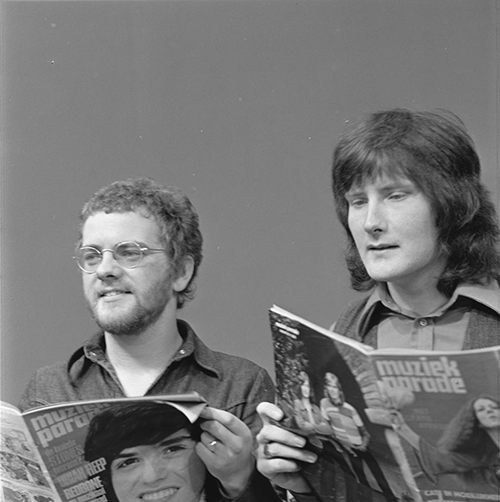
Stealers Wheel were a Scottish folk rock band formed in 1972 in Paisley, Scotland, by former school friends Joe Egan and Gerry Rafferty. Their best-known hit is "Stuck in the Middle with You". The band broke up in 1975 and re-formed briefly in 2008.Egan and Rafferty met as teenagers in Paisley, and became the core of Stealers Wheel. They were initially joined by Roger Brown (guitar), Rab Noakes (guitar, vocals) and Iain Campbell (bass) in 1972. By the time the band was signed to A&M Records later that year, however, Brown, Noakes and Campbell had been replaced by Paul Pilnick (lead guitar), Tony Williams (bass) and Rod Coombes (drums).This second line-up recorded Stealers Wheel (October 1972), produced by American songwriters and producers Leiber & Stoller, and it was a critical and commercial success, reaching No. 50 in the US Billboard 200 album chart, with their hit single "Stuck in the Middle with You" coming from the album. On 7 November 1972 the band appeared on BBC 2's The Old Grey Whistle Test, performing "I Get By" and "Late Again".By the time the first album was released, Rafferty had left the band; Luther Grosvenor filled in for him on tour. Tony Williams also left shortly afterwards, and DeLisle Harper joined on bass for the tour."Stuck in the Middle with You" reached No. 6 in the US Billboard Hot 100 and No. 8 in the UK Singles Chart in 1973, selling over one million copies worldwide, and was awarded a gold disc. With the album also selling well, Rafferty was persuaded to return. However, Grosvenor, Coombes, Pilnick and Harper all left the band. The band then officially became a duo with various backing musicians on guitar, bass and drums.
Biography summary from English Wikipedia, photograph via Wikimedia Commons.
1972Stealers Wheel were a Scottish folk rock band formed in 1972 in Paisley, Scotland, by former school friends Joe Egan and Gerry Rafferty.MILESTONE
1972They were initially joined by Roger Brown (guitar), Rab Noakes (guitar, vocals) and Iain Campbell (bass) in 1972.MILESTONE
1973Releases Ferguslie Park.CAREER
1975The band broke up in 1975 and re-formed briefly in 2008.MILESTONE
2009Releases Stuck in the Middle With You.CAREER
2019Releases In the Bleak Mid Winter.CAREER
—
Gerry Rafferty
CURRENT MEMBER

—
Joe Egan
CURRENT MEMBER

1972
Stealers Wheel
ALBUM

1973
Ferguslie Park
ALBUM
1975
Right or Wrong
ALBUM
1988
The Very Best of
COMPILATION
1990
The Best of Stealers Wheel
COMPILATION
1995
The Very Best of Stealers Wheel
COMPILATION
1998
Stuck in the Middle With You - The Hits Collection
COMPILATION
1998
Stuck in the Middle With You
COMPILATION
2009
Stuck in the Middle With You
ALBUM
2011
Collected
COMPILATION
2017
The A&M Years
COMPILATION
2019
Still the One
ALBUM
2019
In the Bleak Mid Winter
ALBUM
Discography via MusicBrainz.
Reviews
Average rating0Based on 0 ratings
5 ★0
4 ★0
3 ★0
2 ★0
1 ★0
Log in or sign up to rate and review.
Log In / Sign UpNo reviews yet for this band.