
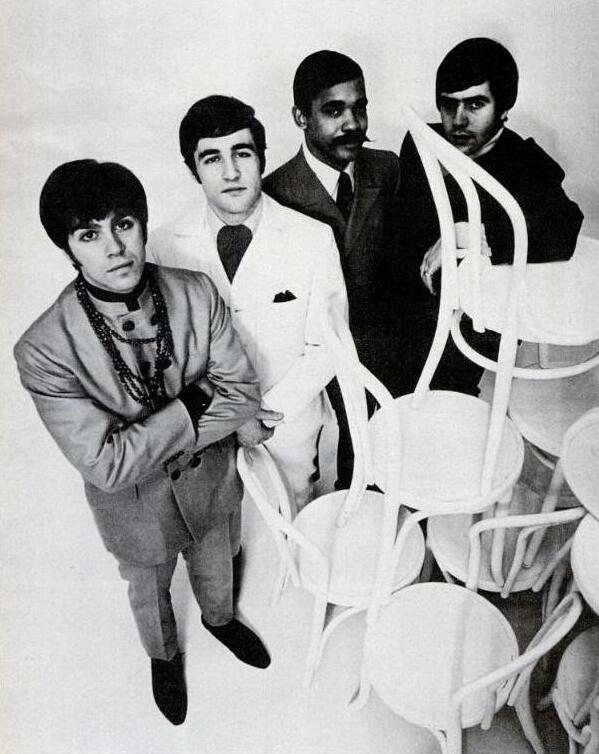
The American Breed were an American rock band from Chicago in the 1960s. The band was originally called Gary & The Knight Lites before adopting the name The American Breed in 1967. The band had a number of charting songs in 1967–68, the best-known of which was "Bend Me, Shape Me". The band broke up in 1970, and members went on to form Rufus after the split.The American Breed originated as a group formed in 1963 by Gary Loizzo in Cicero, Illinois, United States, called Gary & The Knight Lites. Gary & The Knight Lites was influenced by The Everly Brothers and rhythm & blues songs, and they were joined in their first recording session by Charles "Chuck" Colbert whose father owned the recording studio. Songs they recorded included "I'm Glad She's Mine", and "Will You Go Steady". Other releases included "I Don't Need Your Help" and "I Can't Love You Anymore". They also recorded "One, Two, Boogaloo" as The Light Nites. The original members of the group included Gary Loizzo (vocals and guitar), Charles "Chuck" Colbert, Jr. (bass guitar and vocals), Al Ciner (guitar and vocals) and Jim Michalak (drums). In 1965 local drummer Lee Graziano was asked to substitute for Michalak, initially for just a weekend, while the latter was in Las Vegas; however, after Michalak did not return for the two subsequent weekends, Graziano continued to fill the drummer role and ultimately became Michalak's permanent replacement, completing what would become the classic American Breed line-up. Meanwhile, the group would record until 1966 before becoming The American Breed by early 1967.On January 20, 1967 a freak snow storm that dumped twenty inches on Chicago changed the fate of Gary & The Knight Lites when Kenny Myers, former Senior Vice President of Mercury Records, found himself stranded and met with the Breed's producer Bill Traut in his studio at Universal Recording. After Traut played Myers some of the band's tapes, Myers was impressed enough to sign them to his new record label, Acta (a subsidiary of Dot Records, itself owned by Paramount Pictures, whose record holdings later evolved into the Famous Music Group) and suggested they change their name. "They told us Gary and the Knight Lites sounded a little dated", Loizzo told Chicago Tribune in 1994. "So we put a bunch of names in a hat and pulled out American Breed". The band's first single was "I Don't Think You Know Me", written by Carole King and Gerry Goffin.The American Breed enjoyed its greatest success in 1967 and 1968 when five of their singles reached the charts. The first to chart was "Step Out of Your Mind", which reached No. 24 in Billboard Hot 100 in July 1967. The success allowed the group, originally signed for singles, to make albums and quit their daytime gigs to pursue music full-time. The band's biggest success was "Bend Me, Shape Me", which reached No. 5 on the U.S. Billboard Hot 100 chart in 1968. The song, written by Scott English and Larry Weiss, had previously been recorded by an all-female band known as the Models and was also a hit on the UK Singles Chart for the British group Amen Corner. It had also been recorded by The Outsiders after they had reached the top ten with "Time Won't Let Me" in 1966. Contributing to the success of the American Breed's version of "Bend Me, Shape Me" was the arrangement of the song by the band's producer, Bill Traut, who added horns among other changes.The group appeared on the 16 December 1967 episode of the television show American Bandstand along with Pink Floyd. And "Bend Me, Shape Me" went on to sell over one million copies and was awarded a gold disc. It also peaked at No. 24 in the UK Singles Chart, and No. 9 in the German charts. Other hit songs included "Green Light".
Biography summary from English Wikipedia, photograph via Wikimedia Commons.
1963The American Breed originated as a group formed in 1963 by Gary Loizzo in Cicero, Illinois, United States, called Gary & The Knight Lites.MILESTONE
1966It had also been recorded by The Outsiders after they had reached the top ten with "Time Won't Let Me" in 1966.MILESTONE
1967Releases a first studio album, The American Breed.CAREER
1968Releases Bend Me, Shape Me.CAREER
—
Gary Loizzo
CURRENT MEMBER
—
Al Ciner
CURRENT MEMBER
—
Kevin Murphy
CURRENT MEMBER
—
Charles Colbert
CURRENT MEMBER
—
Lee Graziano
CURRENT MEMBER
1967
The American Breed
ALBUM

1968
Pumpkin, Powder, Scarlet & Green
ALBUM
1968
Bend Me, Shape Me
ALBUM
1968
Lonely Side of the City
ALBUM
1993
The Uttermost Incredible Complete Recordings
COMPILATION
1994
Bend Me, Shape Me: The Best of the American Breed
COMPILATION
2016
The Best of the American Breed
COMPILATION
Discography via MusicBrainz.
Reviews
Average rating0Based on 0 ratings
5 ★0
4 ★0
3 ★0
2 ★0
1 ★0
Log in or sign up to rate and review.
Log In / Sign UpNo reviews yet for this band.