
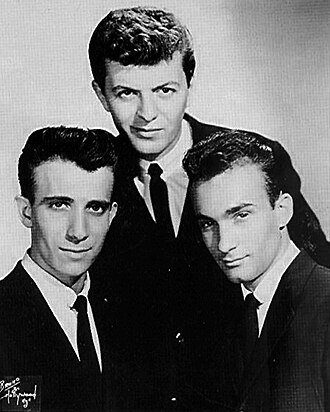
The Belmonts were an American doo-wop group from the Bronx, New York, that originated in the mid-1950s. The original group consisted of Angelo D'Aleo (born February 3, 1940), Carlo Mastrangelo (October 5, 1937 – April 4, 2016), and Fred Milano (August 26, 1939 – January 1, 2012). They took their name from Belmont Avenue, the Bronx street in which Mastrangelo lived, known as the Little Italy of the Bronx. From 1957 to 1960, Dion DiMucci (born July 18, 1939) served as lead vocalist, during which the group was billed as Dion and the Belmonts. At this time Mastrangelo sang the bass parts, Milano the second tenor, D'Aleo the falsetto (first tenor), and DiMucci did lead vocals. During this period, the group released four studio albums and one live album, charting numerous songs on the Billboard Hot 100. The group briefly had limited success after DiMucci's departure, charting several moderate and minor hits during the early 1960s with Mastrangelo on lead vocals. Mastrangelo was replaced in 1962 by Frank Lyndon and Warren Gradus, but the original group reunited in 1966, and thereafter performed together in numerous reunions over the years. They occasionally recorded new singles into the 1980s and performed live into the 21st century. Gradus continued performing live under the moniker until his death in October 2023.The name the Belmonts was derived from Belmont Avenue in the Bronx; two of the four singers having lived on Belmont Avenue, while the other two lived nearby. Carlo Mastrangelo, Angelo D'Aleo, and Fred Milano were part of a gang called the Imperial Hoods. Later addition DiMucci was part of another gang called the Fordham Baldies.The Belmonts' first single, "Teenage Clementine"/"Santa Margherita", was recorded in 1957 for arranger Irving Spice's New York based Mohawk Records. Unlike subsequent recordings, Milano did the lead vocal on the "A" side, "Teenage Clementine", and D'Aleo sang lead on "Santa Margherita". Also recording on the label was Dion DiMucci, whose first release was backed by a group he never met, the Timberlanes. DiMucci added the lead vocal to existing pre-recorded tracks, and the final composition was released as "The Chosen Few"/"Out In Colorado", by "Dion and the Timberlanes" (Mohawk 105). After receiving some airplay on the East Coast, the single was later leased to the larger Jubilee Records label for better distribution, although it failed to chart nationally. DiMucci states that he never knew then, or now, who the Timberlanes were: "The vocal group was so white bread, I went back to my neighborhood and I recruited a bunch of guys, three guys, and we called ourselves Dion and the Belmonts."Initially billed as "Dion with the Belmonts", the new group recorded "We Went Away"/"Tag Along" on the Mohawk label before leaving for newly formed Laurie Records in early 1958. Known thereafter as "Dion and the Belmonts", their first Laurie release, "I Wonder Why" (Laurie Records first release, Laurie 3013), was recorded at New York's Bell Sound Studios and brought them immediate success. Released the first week of May 1958, it appeared on the national charts two weeks later, rising to number 22 on the Billboard Hot 100. It led to their first appearance on the nationally televised American Bandstand, hosted by Dick Clark. The group followed with the ballads "No One Knows" (Laurie 3015, number 19) and "Don't Pity Me" (Laurie 3021, number 40), which were also performed on Bandstand.Dion said of the Belmonts: .mw-parser-output .templatequote{overflow:hidden;margin:1em 0;padding:0 32px}.mw-parser-output .templatequotecite{line-height:1.5em;text-align:left;margin-top:0}@media(min-width:500px){.mw-parser-output .templatequotecite{padding-left:1.6em}}
Biography summary from English Wikipedia, photograph via Wikimedia Commons.
1955–1960Origins and work with DiMucciCAREER
1960–1971DiMucci's departure and singles successCAREER
1972–1989ReunionsCAREER
1991–2011Lawsuit and AnthologyCAREER
2011–2023Death of Milano and final live performancesCAREER
1962
Carnival of Hits
ALBUM

1969
Summer Love
ALBUM
1988
Street Corner Symphony
COMPILATION
1990
Seasons of Harmony
ALBUM
1991
Carlo & The Belmonts
COMPILATION
1995
Lost Treasures
COMPILATION
1995
The Laurie, Sabina & United Artists Sides, Volume 1
COMPILATION
1998
The Laurie, Sabina & United Artists Sides, Volume 2
COMPILATION
2002
Tell Me Why: The Very Best Of The Belmonts
COMPILATION
2013
Golden Oldies
COMPILATION
—
Cigars Acappella Candy
ALBUM
Discography via MusicBrainz.
Reviews
Average rating0Based on 0 ratings
5 ★0
4 ★0
3 ★0
2 ★0
1 ★0
Log in or sign up to rate and review.
Log In / Sign UpNo reviews yet for this band.