
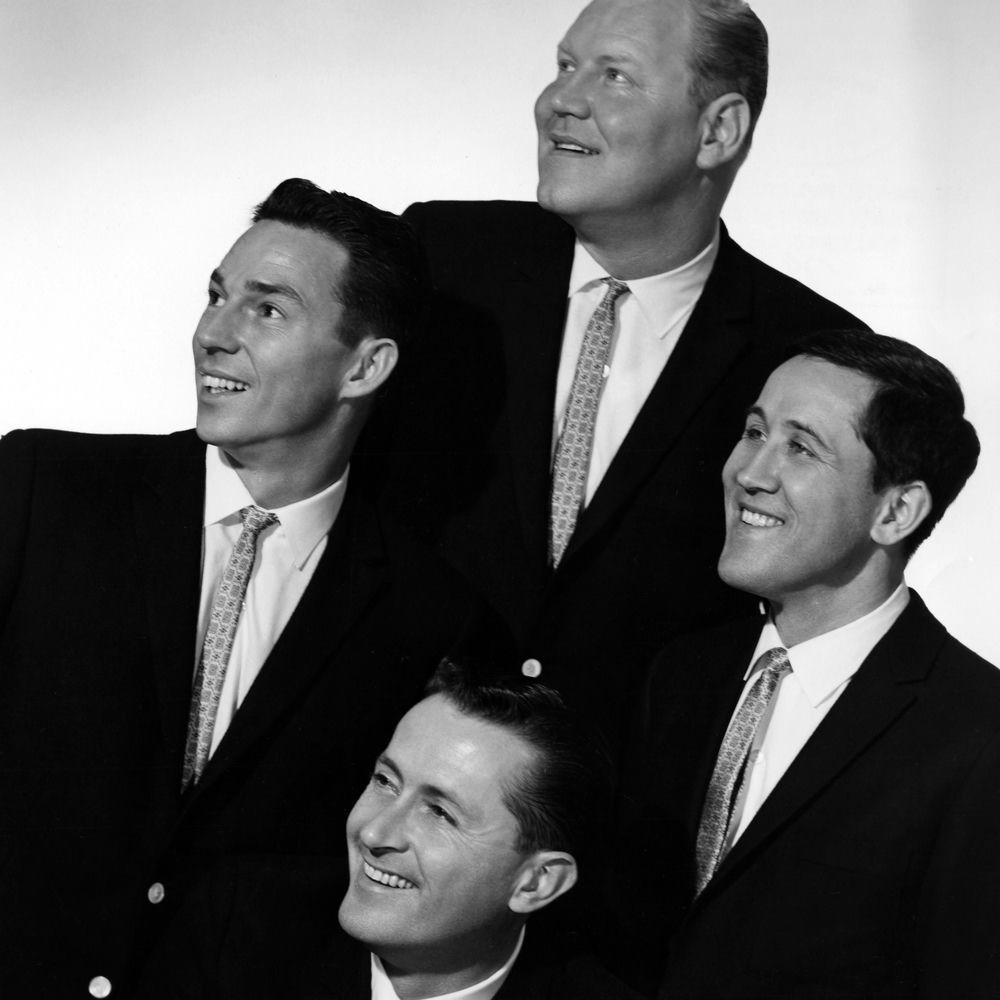
The Four Freshmen are an American male vocal quartet founded in the barbershop tradition. Its influences include the big band vocal group sounds of The Modernaires, The Pied Pipers, and The Mel-Tones. The singers accompany themselves on guitar, horns, bass, and drums, among other instrumental configurations.The group was founded in 1948 in Indiana and reached its peak popularity in the mid-1950s. The last original member retired in 1993, but the group continues to tour internationally. It has recorded jazz harmonies since its founding in the late 1940s in the halls of the Jordan School of Music at Butler University in Indianapolis.Brothers Don and Ross Barbour grew up in a musical family in Columbus, Indiana, and had sung with their cousin Bob Flanigan as kids. In 1947, while attending the Arthur Jordan Conservatory of Music at Butler University in Indianapolis, Indiana, music theory classmate Hal Kratzsch convinced the Barbours that forming a barbershop quartet would be a great source of income, so they formed a barbershop quartet called Hal's Harmonizers. Kratzsch knew from instinct how to sing the bottom part; Don, with his wide vocal range, was tapped to sing the second part; and Ross, a natural baritone, took the third part. To sing the top part, they recruited classmate Marvin Pruitt. They would perform songs like "Sweet Adeline" at fairs and conventions while wearing armbands, exaggerated false mustaches, and waiters' aprons. Bored with the confinement of barbershop chords, and not wanting to give up their income base, they renamed themselves as the Toppers, and experimented with more complex chords and jazz arrangements. At first, the group was influenced by Glenn Miller's quartet, The Modernaires, and Mel Tormé's Mel-Tones, but soon developed its own style of improvised vocal harmony.As the Toppers' popularity grew, Pruitt developed stage fright and resigned. Initially, they replaced him with Ross's girlfriend and future wife Nancy Sue Carson, but feeling that a fourth male voice would be more appropriate for the group's sound, the Barbour brothers contacted Flanigan, who was living in Greencastle, Indiana and had previously been part of a high school quintet singing songs inspired by the Modernaires, to become their new lead singer. In the meantime, they started accompanying themselves with musical instruments: Don, having played guitar through high school and a couple of years in Arabia with the Air Force, on guitar; Ross, first on piano, then on drums; Flanigan, who played trombone through his army time in Germany, except when the dance band needed a bass player, alternating between string bass and trombone, and Kratzsch, who played trumpet in high school and in the Navy in the South Pacific, on trumpet, mellophone and string bass. Soon, the group dropped out of school and drove to Chicago, where they met agent Dick Shelton. As he already had a group called the Cottontoppers, he renamed them as the Freshmen Four, which they reversed to the Four Freshmen. They made their debut at Fort Wayne's 113 Club on September 20, 1948, and nearly lost the job since the manager had never heard jazz chords, but his daughter had a crush on Kratzsch, allowing them to stay for a week.Soon, the Four Freshmen drew the admiration of jazz legends such as Dizzy Gillespie and Woody Herman. On March 21, 1950, Stan Kenton heard the quartet at the Esquire Lounge in Dayton, Ohio. He "had been told at his own show earlier that night about a quartet in town that sounded like his 43-piece ensemble", and was sufficiently impressed that on April 14, he arranged for an audition with his label, Capitol Records, which signed them later that year. The demo included "Laura", "Basin' Street Blues", "Dry Bones", and two other songs. In 1950, they released a single, "Mr. B's Blues", and appeared in their first and only film, Rich, Young and Pretty, where they sang "How D'Ya Like Your Eggs In The Morning" with Jane Powell and Vic Damone. The Freshmen released another single in 1951, "Now You Know", which was not a commercial success. Later in the year Capitol rejected their proposed next single, "It's a Blue World", and dropped them from the label. In May of the following year, a furious Stan Kenton demanded that the record company send them the demo tapes so that they could promote the song themselves. They managed to get the song onto the radio, and in 1952, "It's a Blue World" became their first charted single. Capitol re-signed the group in July of the same year.
Biography summary from English Wikipedia, photograph via Wikimedia Commons.
1947In 1947, while attending the Arthur Jordan Conservatory of Music at Butler University in Indianapolis, Indiana, music theory classmate Hal Kratzsch convinced the Barbours that forming a barbershop quartet would be a great source…MILESTONE
1948The group was founded in 1948 in Indiana and reached its peak popularity in the mid-1950s.MILESTONE
1948They made their debut at Fort Wayne's 113 Club on September 20, 1948, and nearly lost the job since the manager had never heard jazz chords, but his daughter had a crush on Kratzsch,…MILESTONE
1950In 1950, they released a single, "Mr.MILESTONE
1951The Freshmen released another single in 1951, "Now You Know", which was not a commercial success.MILESTONE
1952They managed to get the song onto the radio, and in 1952, "It's a Blue World" became their first charted single.MILESTONE
1993The last original member retired in 1993, but the group continues to tour internationally.MILESTONE
1954
Voices in Modern
ALBUM

1955
Four Freshmen and 5 Trombones
ALBUM
1957
Four Freshmen and 5 Saxes
ALBUM
1958
Voices In Latin
ALBUM
1959
Four Freshmen and 5 Guitars
ALBUM
1960
Freshmen Favorites
ALBUM
1960
Road Show
LIVE
1961
The Freshman Year
ALBUM
1962
The Swingers: 12 Jazz Favorites by The Four Freshmen
COMPILATION
1962
Stars in Our Eyes
ALBUM
1964
Funny How Time Slips Away
ALBUM
1964
More 4 Freshmen And 5 Trombones
ALBUM
1968
Today Is Tomorrow!
ALBUM
1968
A Today Kind Of Thing
ALBUM
1969
In A Class By Themselves
ALBUM
1969
Different Strokes
ALBUM
1986
Live at Butler University
LIVE
1991
Capitol Collectors Series
COMPILATION
1992
Fresh!
ALBUM
1992
Graduation Day
ALBUM
1993
Spotlight on the Four Freshmen (Great Gentlemen of Song)
COMPILATION
1993
Voices in Love / Love Lost
ALBUM
1993
Greatest Hits
COMPILATION
1993
More 4 Freshmen and 5 Trombones / The Four Freshmen in Person, Volume 2
ALBUM
1994
Voices in Standards
ALBUM
1994
Day by Day
COMPILATION
1995
Billy May and his Orchestra
ALBUM
1996
5 Trombones & 5 Trumpets
ALBUM
1997
Easy Street
ALBUM
1999
Still Fresh
ALBUM
1999
Voices in Latin / The Freshman Year
ALBUM
2000
Stars In Our Eyes & The Swingers
COMPILATION
2002
First Affair / Voices in Fun
ALBUM
2002
Best of the Four Freshmen: The Liberty Years
COMPILATION
2002
The Complete Capitol Fifties Sessions
COMPILATION
2004
Complete 1950-1954 Studio-Issued Recordings
COMPILATION
2005
In Session
ALBUM
2005
Four Freshmen in Person / Voices and Brass
ALBUM
2007
Snowfall
ALBUM
2012
The Four Freshmen Day by Day
COMPILATION
2015
Newport Beach Jazz Party
LIVE
2022
The Four Freshmen Featuring Emmet Cohen, Russell Hall, & Kyle Poole
ALBUM
2025
The Four Freshmen Featuring Emmet Cohen, Russell Hall, & Kyle Poole, Vol. 2
ALBUM
—
Live From Las Vegas
ALBUM
Discography via MusicBrainz.
Reviews
Average rating0Based on 0 ratings
5 ★0
4 ★0
3 ★0
2 ★0
1 ★0
Log in or sign up to rate and review.
Log In / Sign UpNo reviews yet for this band.