
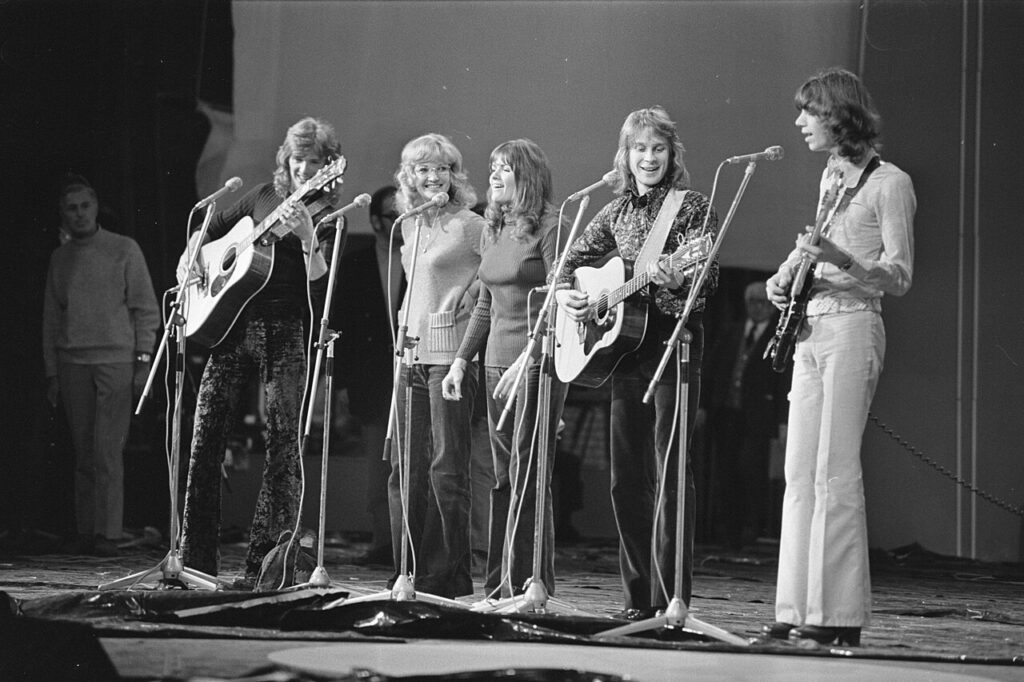
The New Seekers were a British pop group, formed in London in 1969 by Keith Potger, after the break-up of his group, the Seekers. The idea was that the New Seekers would appeal to the same market as the original Seekers, but their music would have pop as well as folk influences. They achieved worldwide success in the early 1970s with hits including "I'd Like to Teach the World to Sing", "You Won't Find Another Fool Like Me" and "Beg, Steal or Borrow".The group were formed after the disbanding of the successful 1960s Australian group the Seekers. Keith Potger, a member of the Seekers, put together the New Seekers in 1969, featuring Laurie Heath, Chris Barrington, Marty Kristian, Eve Graham and Sally Graham (no relation), the last of whom had been a member of The Young Generation. Potger himself had also performed and recorded with the group.Despite their having released only one album with no commercial success, ITV's Scottish Television gave the group their own TV series, Finders, Seekers. The line-up for this version of the group hosting the series was Keith Potger, Eve Graham, Sally Graham, Laurie Heath, Marty Kristian and Chris Barrington. Produced in colour, the show was given a prime-time slot, starting on 27 March 1970 (Good Friday) and continuing for seven shows. The public did not take to the show, with several complaints seemingly targeted at the band. Despite the complaints, the series was shown on several ITV channels, sold to Canada, Australia and Sweden with interest from other countries as a result of being shown at the international television market in Cannes.Following the series' failure, later in 1970, after one album release, the line-up was reworked to comprise Eve Graham, Kristian, Lyn Paul, Peter Doyle and Paul Layton. This line-up found instant success with their debut release, a cover of Melanie Safka's "What Have They Done to My Song, Ma" (titled in the U.S. as "Look What They've Done to My Song, Ma"), which became a top 20 hit in the US, No. 3 in Canada, and a minor one in the UK.Over the next year, the group released a number of singles to little recognition, but it was in June 1971 that they released their breakthrough hit, "Never Ending Song of Love" (the first of many hit songs to be produced by David Mackay, and a cover of the American hit by Delaney & Bonnie). The song became a big hit in the UK, spending five weeks at No. 2 in the UK Singles Chart, and was one of the biggest selling singles of the year. This was their last single released on the Philips Records label. The huge success of this single was mildly ironic in that prior to the single's release, the group were dropped by Philips and had signed with Polydor Records. Their first single for Polydor was "Good Old Fashioned Music", which they promoted on television (including an appearance on Top Of The Pops), but it failed to chart. Towards the end of 1971, the group recorded an adaptation of the Coca-Cola jingle, "I'd Like to Buy the World a Coke", which had gained much interest. Reworked as "I'd Like to Teach the World to Sing", the song became a worldwide success. It made No. 1 in the UK for four weeks and sold just under a million copies. In the US, the song was also a hit, reaching No. 7, and in Canada it reached No. 3. It became a No. 1 hit in many other countries and is the most recognised song by the group.
Biography summary from English Wikipedia, photograph via Wikimedia Commons.
1969The New Seekers were a British pop group, formed in London in 1969 by Keith Potger, after the break-up of his group, the Seekers.MILESTONE
1970Following the series' failure, later in 1970, after one album release, the line-up was reworked to comprise Eve Graham, Kristian, Lyn Paul, Peter Doyle and Paul Layton.MILESTONE
1971Over the next year, the group released a number of singles to little recognition, but it was in June 1971 that they released their breakthrough hit, "Never Ending Song of Love" (the first of…MILESTONE
1972Releases Circles.CAREER
1973Releases Now.CAREER
1974Releases Farewell Album.CAREER
1978Releases Anthem - One Day in Every Week.CAREER
1982Releases Tell Me.CAREER
1996Releases The New Seekers.CAREER
2003Releases We’d Like to Teach the World to Sing.CAREER
2009Releases Together Again / Anthem.CAREER
1970
New Seekers
ALBUM

1970
Keith Potger & The New Seekers
ALBUM
1971
New Colours
ALBUM
1971
Beautiful People
ALBUM
1972
We’d Like to Teach the World to Sing
ALBUM
1972
Festival Eurovision 1972
EP
1972
Circles
ALBUM
1972
Come Softly to Me
ALBUM
1972
Live At The Royal Albert Hall
LIVE
1973
Pinball Wizards
ALBUM
1973
Now
ALBUM
1973
In Perfect Harmony
COMPILATION
1973
You Won’t Find Another Fool Like Me
COMPILATION
1973
The Best of The New Seekers
COMPILATION
1974
Together
ALBUM
1974
Farewell Album
ALBUM
1974
Попрошу
EP
1978
Anthem - One Day in Every Week
ALBUM
1982
Tell Me
ALBUM
1987
Greatest Hits
COMPILATION
1987
Greatest Hits
COMPILATION
1991
The Greatest Hits
COMPILATION
1992
Shang A Lang
COMPILATION
1993
Gold
COMPILATION
1995
Anthems: Their Very Best
COMPILATION
1996
The New Seekers
ALBUM
1996
The World of the New Seekers
COMPILATION
1996
Perfect Harmony
COMPILATION
1998
Greatest Hits
COMPILATION
1999
Juke Box Jive
COMPILATION
2003
We’d Like to Teach the World to Sing
ALBUM
2003
The Singles
COMPILATION
2005
The New Seekers Retro Gold
COMPILATION
2006
Songbook 1970-1974
COMPILATION
2009
It’s Been Too Long, the Greatest Hits and More
COMPILATION
2009
Together Again / Anthem
ALBUM
2019
The Albums 1970-73
COMPILATION
—
Come Softly to Me - We’d Like to Teach the World to Sing
COMPILATION
—
Greatest Hits
COMPILATION
—
Perfect Harmony
COMPILATION
—
Teach the World to Sing
COMPILATION
Discography via MusicBrainz.
Reviews
Average rating0Based on 0 ratings
5 ★0
4 ★0
3 ★0
2 ★0
1 ★0
Log in or sign up to rate and review.
Log In / Sign UpNo reviews yet for this band.