
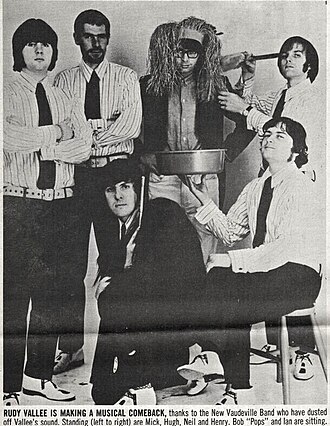
The New Vaudeville Band was an English group created by songwriter Geoff Stephens in 1966 to record his novelty composition "Winchester Cathedral", a song inspired by the dance bands of the 1920s and a Rudy Vallée megaphone-style vocal. To his surprise, the song became a transatlantic hit that autumn, reaching the Top 10 in the United Kingdom and rising to No. 1 in the United States. The New Vaudeville Band initially was a studio group composed of session players, but Stephens quickly assembled a permanent group to continue recording and to play live shows. The group has been periodically revived since, without Stephens' participation.The New Vaudeville Band placed several singles in the US and UK Top 40 through 1967. The group was nominated for two Grammy Awards, one for Record of the Year and they won in the Contemporary (R&R) Recording category for the 9th Annual Grammy Awards.The original version of the New Vaudeville Band was an assemblage of studio musicians, specifically gathered by Geoff Stephens to record the song "Winchester Cathedral", which he both wrote and produced. The record sold over three million copies worldwide, earning the RIAA certification of gold disc status. The track also won a Grammy Award for Best Contemporary Song in 1967. The lead vocal was sung by John Carter, formerly of the Ivy League, who had sung on the demo of the song, which Stephens decided to keep for the commercial release.When Stephens received several requests for the New Vaudeville Band to tour and to record an album, he had to put together a group, for the song had been recorded by session musicians hired only for the recording. He contacted the Bonzo Dog Doo-Dah Band, which played similar music at the time. Only Bob Kerr from that group was interested, so he left the Bonzos in order to help Stephens form a touring version of the New Vaudeville Band, which included original session drummer Henri Harrison. Meanwhile, John Carter had no interest in continuing with the group as a singer, though he still co-wrote the occasional song with Stephens for use by the group. The new lead singer of the group was Alan Klein, who was billed as 'Tristam, Seventh Earl of Cricklewood'. Klein also wrote some of the group's material. Mick Wilsher, on guitars, also sang occasional lead vocals. The official line-up as of late 1966 was:Stephens was not officially part of the group, but produced and arranged their recordings, wrote or co-wrote much of the original material, and selected the cover tunes that the group played.
Biography summary from English Wikipedia, photograph via Wikimedia Commons.
1966FoundationCAREER
1966Assembling the continuing bandCAREER
1967The track also won a Grammy Award for Best Contemporary Song in 1967.MILESTONE
1966
Winchester Cathedral
ALBUM

1966
New Vaudeville Band
EP
1967
Finchley Central
ALBUM
1979
The Best of the New Vaudeville Band
COMPILATION
1980
Live Vaudeville
LIVE
1997
Winchester Cathedral
COMPILATION
2007
Winchester Cathedral / Finchley Central
COMPILATION
—
Winchester Cathedral
COMPILATION
Discography via MusicBrainz.
Reviews
Average rating0Based on 0 ratings
5 ★0
4 ★0
3 ★0
2 ★0
1 ★0
Log in or sign up to rate and review.
Log In / Sign UpNo reviews yet for this band.