
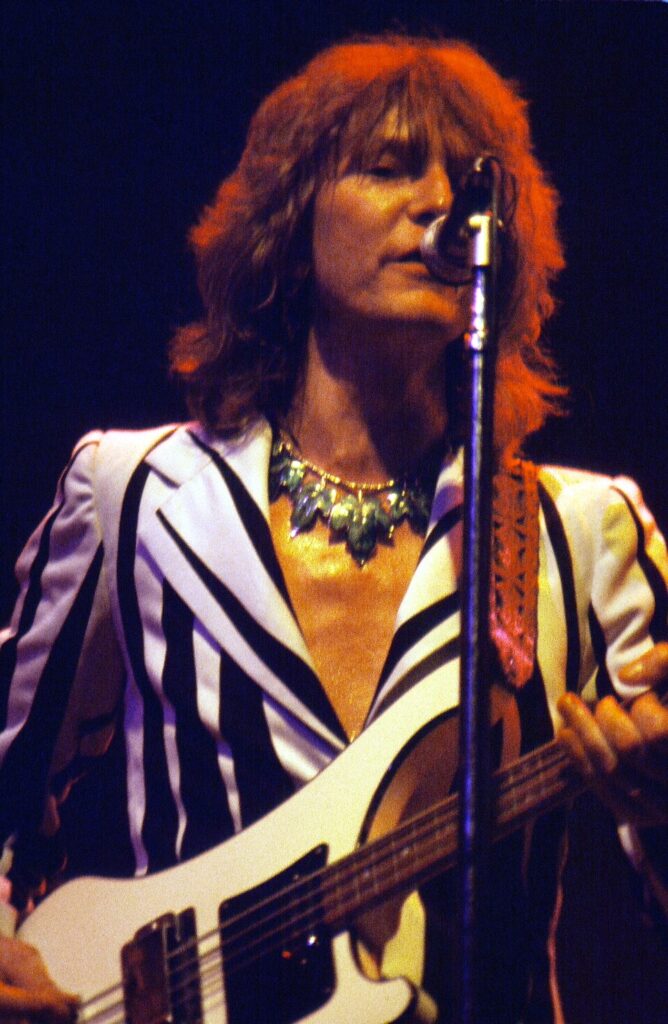
IN MEMORIAM 1948 – 2015
Chris Squire
Bass Guitar, Vocals with Yes.
Art Rock Progressive Rock Symphonic Rock
Not rated0 Fans
Christopher Russell Edward Squire (4 March 1948 – 27 June 2015) was an English musician, singer and songwriter best known as the bassist, backing vocalist, and only constant member of the progressive rock band Yes until his death in 2015. In 2017, he was posthumously inducted into the Rock and Roll Hall of Fame as a member of Yes.
Squire was widely regarded as the dominant bassist among the English progressive rock bands, influencing peers and later generations of bassists with his incisive sound and elaborately contoured, melodic bass lines. His name was associated with his trademark instrument, the Rickenbacker 4001 (British model RM1999). From 1991 to 2000, Rickenbacker produced a limited-edition signature model bass in his name, the 4001CS.
Squire was born on 4 March 1948 in the north-west London suburb of Kingsbury, to Peter and Joanne Squire. He grew up there and in the nearby Queensbury and Wembley areas. His father was a cab driver and his mother a secretary for an estate agent. As a youngster Squire took a liking to records by Lena Horne and Ella Fitzgerald that belonged to his father, though his main interest was church music. At the age of six, he joined the church choir at St. Andrew's in Kingsbury as a treble along with Andrew Pryce Jackman, a friend who lived nearby. The choir got to perform at St. Paul's Cathedral. Their choirmaster Barry Rose was an early influence on Squire. "He made me realise that working at it was the way to become best at something". Squire also sang in the choir at his next school, Haberdashers' Aske's Boys' School, then located in Hampstead. He played the harmonica on his way home from school.
Squire did not consider a music career until the age of sixteen when the Beat music boom in the early 1960s and the emergence of the Beatles inspired him to "be in a group that don't use music stands". A schoolfriend recommended that Squire take up the bass after pointing out his tall frame and large hands, thinking they were ideal for playing the instrument. Squire then purchased his first bass, a Futurama, which he described as "very cheap, but good enough to learn on". In 1964, on the last day before the summer holidays, Squire's headmaster suspended him and a friend for having their hair too long and they were given two shillings and sixpence to have it cut. Instead, they went home and never returned. After his mother took him to a recruitment agency and enquired for work related to music, Squire landed work selling guitars at a Boosey & Hawkes shop in Regent Street. He used the staff discount offer to purchase a new bass, a Rickenbacker 4001, in 1965.
Squire's first band was the Syn, a rock and rhythm and blues band that featured Jackman on keyboards and Martin Adelman on drums. Their first public performance took place at The Graveyard, a youth club in the hall of St. Andrew's. In 1965, following several personnel changes, Squire, Jackman and Adelman teamed with singer Steve Nardelli, guitarist John Painter, and Icelandic drummer Gunnar Jökull Hákonarson to form a new group, the Syn. The group performed Tamla Motown covers before they changed direction towards psychedelic rock. After several months, Painter was replaced by guitarist Peter Banks. The new line-up gained a following large enough to secure a weekly residency at the Marquee Club in Soho, which was followed by a recording contract with Deram Records. The band once opened for The Jimi Hendrix Experience at the venue, "So I saw what was possible, and I just had this innate faith that I was going to make it." Together they released two singles before they disbanded.
Biography summary from English Wikipedia, photograph via Wikimedia Commons.
1948
Born March 4, 1948 in United Kingdom
BIRTH
2017
In 2017, he was posthumously inducted into the Rock and Roll Hall of Fame as a member of Yes.
MILESTONE
—
Member of Yes
BAND
2015
Died in 2015
IN MEMORIAM
Reviews
Average rating0Based on 0 ratings
5 ★0
4 ★0
3 ★0
2 ★0
1 ★0
Log in or sign up to rate and review.
Log In / Sign UpNo reviews yet for this artist.