
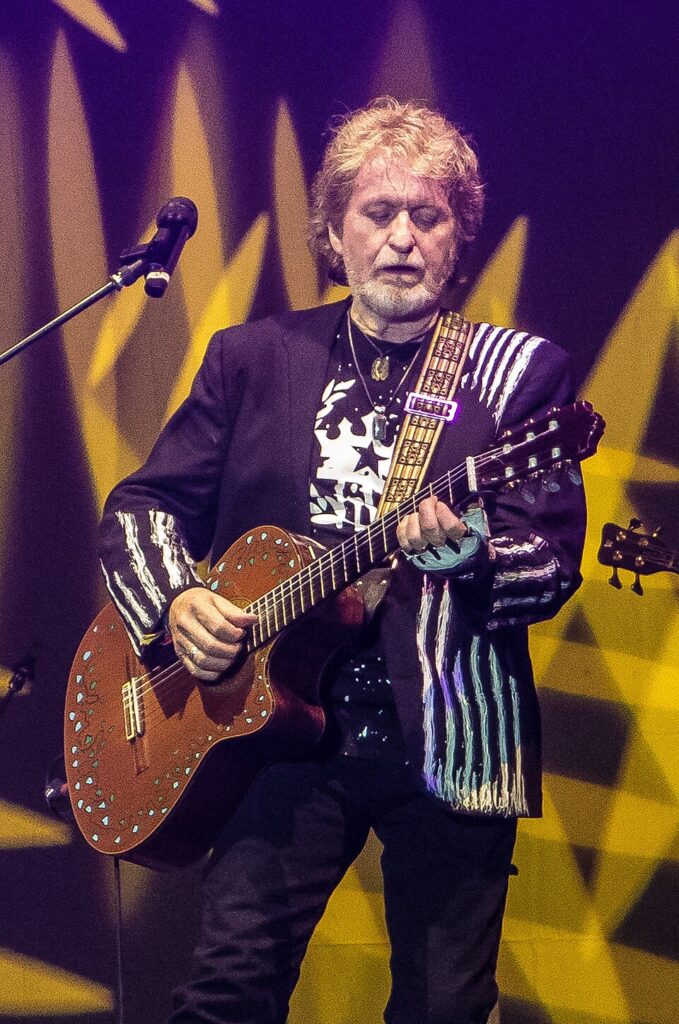
ARTIST PROFILE b. 1944
Jon Anderson
Guitar, percussion, Vocals with Yes.
new-age Pop Rock Progressive Rock Symphonic Rock
Not rated0 Fans
Jon Anderson (born John Roy Anderson, 25 October 1944) is an English singer, songwriter, and musician who co-founded the progressive rock band Yes with bassist Chris Squire in 1968 and rose to prominence as their lead vocalist. The band pioneered progressive rock in the 1970s, particularly with their critically-acclaimed albums The Yes Album, Fragile (both 1971) and Close to the Edge (1972) which display Anderson's role in crafting the group's sound as one of the main songwriters and lyricists. Known for his high tenor vocal style, Anderson was a member of Yes across three tenures: from 1968 to 1980, 1983 to 1988, and 1990 to 2008.
Born and raised in Accrington in northern England, Anderson gave up manual labour in the early 1960s in favour of singing in The Warriors with his brother. He moved to London and after several unsuccessful singles as a solo artist and co-formed Yes with Squire. Anderson left the band in 1980 due to growing internal friction and continued his solo career, which he had started in 1976 with his debut album, Olias of Sunhillow. He went on to collaborate with other musicians, including Greek keyboardist and composer Vangelis as Jon and Vangelis, Roine Stolt as Anderson/Stolt, Jean-Luc Ponty as the Anderson Ponty Band, and The Band Geeks as Jon Anderson and the Band Geeks, with whom he has toured repeatedly and released two albums in recent years. He has appeared on albums by King Crimson, Toto, Lawrence Gowan, Tangerine Dream, Iron Butterfly, Milton Nascimento, Battles, Mike Oldfield and Kitaro. Anderson was a member of the offshoot Yes groups Anderson Bruford Wakeman Howe and Yes Featuring Jon Anderson, Trevor Rabin, Rick Wakeman.
In 2009, Anderson acquired American citizenship. In 2017, he was inducted into the Rock and Roll Hall of Fame as a member of Yes. In 2026, Loudwire ranked him as the greatest progressive rock singer of all time.
John Roy Anderson was born on 25 October 1944 in Accrington, Lancashire, England. His father Albert was from Glasgow, Scotland, and served in the army in the entertainment division and later worked as a salesman; his mother Kathleen was of Irish and French ancestry and worked in a cotton mill, cotton being the biggest export from Lancashire at the time. Together they became county champions in ballroom dancing, winning several awards. Anderson said they named him after an English singer who toured as "John Roy the Melody Boy" and the Scottish name Royston. Anderson grew up on Norfolk Street with brothers Tony and Stuart, and sister Joy. He is the third youngest. As a youngster, Anderson became a fan of several musicians, including Elvis Presley, Eddie Cochran, the Everly Brothers, and Jon Hendricks.
Anderson attended St. John's School where he organised daily football matches during lunch break. He was not a strong academic, and remembered he "was always getting into trouble for messing around and singing too loud". There, he made a tentative start to a musical career, playing the washboard in Little John's Skiffle Group who performed songs by Lonnie Donegan, among others. At fifteen, Anderson left school after his father became ill and took up work on a farm, as a lorry driver transporting bricks, and as a milkman to help support the family. A keen football fan, he tried to pursue a career at Accrington Stanley F.C., but at 5 feet 5 inches (1.65 m) tall, he was turned down because of his frail constitution. He remained a fan of the club, and was a ball boy and mascot for the team for one year.
Biography summary from English Wikipedia, photograph via Wikimedia Commons.
1944
Born October 25, 1944 in United Kingdom
BIRTH
1962–1968
The Warriors and early singles
CAREER
1968–1980
Forming Yes and start of solo career
CAREER
1980–1990
Solo career, return to Yes, and ABWH
CAREER
1990–2004
Return to Yes and solo career
CAREER
2004–2009
Resuming solo career
CAREER
2010–2023
Solo work, collaborations, Yes feat. ARW and tours
CAREER
2024–present
True, Live – Perpetual Change and touring
CAREER
1968–2004
Member of Yes
BAND · 1968–2004
1976
Olias of Sunhillow
STUDIO

1980
Song of Seven
STUDIO
1982
Animation
STUDIO
1985
3 Ships
STUDIO
1988
Hold On to Love
EP
1988
In the City of Angels
STUDIO
1994
Change We Must
STUDIO
1994
Deseo
STUDIO
1994
The Best of South America 1993
LIVE
1995
Angels Embrace
STUDIO
1995
The Deseo Remixes
STUDIO
1995
The Sky and His Shadow
STUDIO
1996
The Lost Tapes of Opio
STUDIO
1996
Toltec
STUDIO
1997
Earthmotherearth
STUDIO
1997
The Promise Ring
STUDIO
1998
The More You Know
STUDIO
1999
Chagall
STUDIO
2005
Tour of the Universe
LIVE
2006
Interview
STUDIO
2006
Live in Sheffield 1980
LIVE
2006
Searching for the Songs
STUDIO
2006
The Lost Tapes Sampler
COMPILATION
2006
Watching the Flags That Fly
STUDIO
2007
Binaural in Boston
LIVE
2007
Live From La La Land
LIVE
2007
The Mother’s Day Concert
LIVE
2008
From Me to You
STUDIO
2008
Reason to Live
STUDIO
2010
State of Independence
LIVE
2010
Survival & Other Stories
STUDIO
2010
The Living Tree
STUDIO
2011
Open
EP
2011
The Living Tree in Concert, Part One
LIVE
2016
Guitar Concerto
EP
2016
Invention of Knowledge
STUDIO
2019
1000 Hands: Chapter One
STUDIO
2020
The Lost Demos EP
STUDIO
2021
Songs From Another World
COMPILATION
2021
Sunlight
STUDIO
2023
Independent Stateside
LIVE
2024
True
STUDIO
2025
Live: Perpetual Change
LIVE
—
The Fellowship
EP
Discography via MusicBrainz.
Reviews
Average rating0Based on 0 ratings
5 ★0
4 ★0
3 ★0
2 ★0
1 ★0
Log in or sign up to rate and review.
Log In / Sign UpNo reviews yet for this artist.